

There’s something magical about visiting a place you’ve read about for years and finally standing right there, breathing in its air.
When I set out from Pune towards the Bhaja Caves one crisp morning, I knew I was headed for one of Maharashtra’s oldest Buddhist sites, but I didn’t expect the visit to feel so personal.
The journey wound through green hills, small villages, and an unhurried pace of life — almost like the road itself was preparing me to step back into the 2nd century BCE.

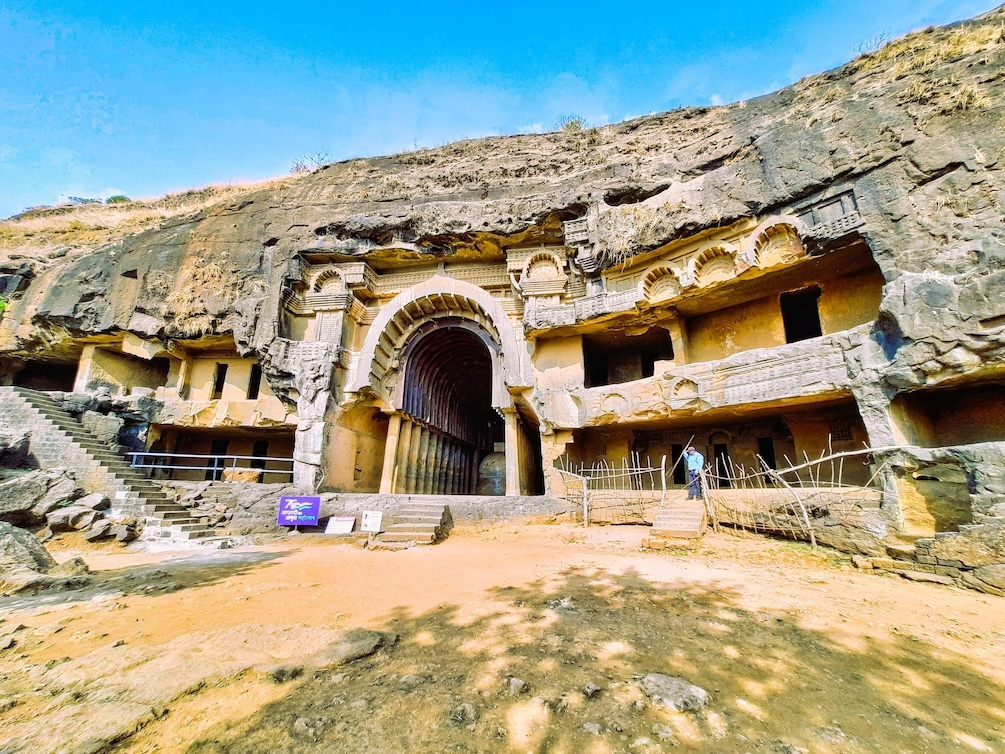
A short uphill climb brought me face-to-face with the weathered rock façade. I paused at the Archaeological Survey of India board, taking in the fact that this wasn’t just a tourist stop — it’s a nationally protected monument that has silently witnessed over two millennia of history.
The Story Behind Bhaja Caves
Bhaja Caves are a group of 22 rock-cut Buddhist caves located near Lonavala in Pune district. Dating back to the Theravada branch of the Hinayana school of Buddhism, they were active from around the 2nd century BCE — contemporaries of the Mauryan period in North India.
Back then, this site stood along a vital trade route connecting the Arabian Sea to the Deccan Plateau, welcoming monks, pilgrims, and traders alike.
Standing there, I tried to imagine the caves bustling with travelers — the smell of incense from the prayer hall, the faint chanting of monks, the clink of merchants’ wares being unloaded outside.

ALSO READ Epic Pune to Leh Ladakh Bike Trip
The Chaitya Hall – Heart of the Caves
The first cave that pulled me in was the grand Chaitya (prayer hall). The horseshoe-shaped entrance instantly stood out, perfectly framing the sunlight. Inside, the arched roof still bears ancient wooden beams — a rare survival after all these centuries.
Twenty-seven octagonal pillars stand like silent guardians, guiding your eyes to the stupa at the far end.
I found myself slowing my pace here. The space has that rare quality where sound seems to soften, and you can almost hear the echo of voices from another time.
The Stupas – Stone Stories of Monks
Bhaja has 14 stupas — five inside and nine outside. These aren’t just stone mounds; they’re memorials to monks who once called this place home. Some even bear names — Sanghadina, Ampinika, Dhammagiri — etched into history.
Seeing those inscriptions gave me a strange feeling of closeness, like I was meeting the people who had lived here centuries ago.
Viharas – Living Quarters of the Past
The viharas here were the monks’ residences — simple stone rooms with platforms carved out for beds. Some caves might also have welcomed passing traders and pilgrims.
I stepped into one and imagined a monk sitting cross-legged on the platform, deep in meditation, while outside the cave, life bustled along the trade route.
One vihara caught my attention — its carvings depict the Sun god riding a chariot and Indra on horseback. It’s a reminder that even here, Buddhist art often wove in wider cultural and mythological elements.
Art and Sculptures – Where History Speaks in Stone
Bhaja’s sculptures are rich in symbolism. Instead of depicting Buddha directly, they use symbols like the lotus, Bodhi tree, elephant, and throne.


But the most surprising carving for me? A woman playing a percussion instrument believed to be an early form of the tabla — alongside dancers. This single sculpture challenges the belief that tabla came from outside India, pointing instead to a local origin.
Elsewhere, carvings show royal women driving chariots, mythical scenes, and decorative motifs. And if you visit in the late afternoon, the setting sun’s rays filter in perfectly, illuminating the carvings — a detail that feels both artistic and spiritual.
Bhaja Caves Beyond Stone
For me, Bhaja isn’t just about architecture — it’s about connection.
It’s the way history, religion, and daily life merge here. The caves speak of meditation and trade, of myth and craftsmanship, of a community that saw beauty in both simplicity and detail.
Travel Tips from My Visit
- Best time to visit: August–February, especially post-monsoon when the hills are lush.
- Footwear: Wear comfortable shoes for the uphill climb.
- Photography: Permitted with a small fee — totally worth it.
- Nearby attractions: Karla Caves, Lohagad Fort, Pawna Lake.
Why You Should Go
If you love history, Bhaja Caves will give you an intimate look into early Buddhist architecture. If you’re a traveler, the setting will soothe your soul. And if you’re simply curious, you’ll leave with stories carved in stone and sunlight.
As I walked back down the hill, I kept glancing over my shoulder for one last look. The caves stood there, quiet but alive — holding onto the stories of monks, traders, and travelers who, like me, had once stopped to listen.