


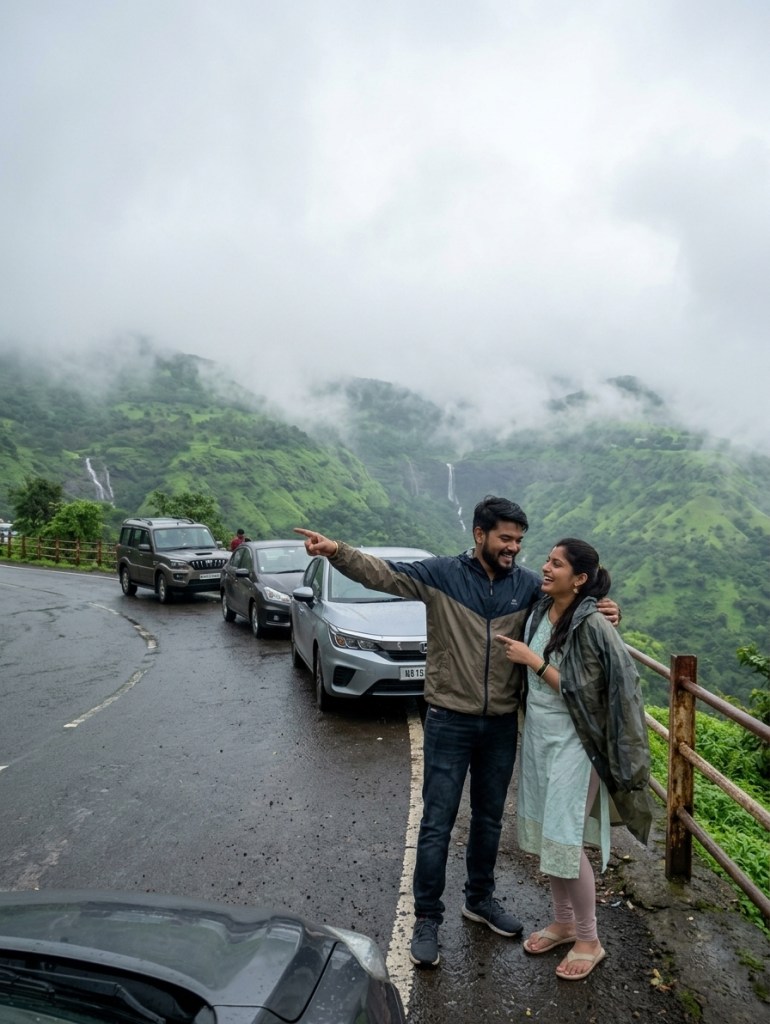
Last month, a couple from Kothrud messaged us on Instagram — they’d driven 90 kilometers to Lonavala on a Saturday, circled the viewpoint for 45 minutes looking for parking, and turned back without getting out of the car. They asked if we ever faced this. Every single weekend.
The most common question we get isn’t “what’s the best place near Pune?” It’s “where do we actually park once we get there?” No travel blog talks about it. Google Maps shows you the route but not where to leave your car. And half the time, locals wave you toward spots that either don’t exist or cost more than your hotel room.
We’re Ketan and Samprita from Musafir Couple, and we’ve been weekend-tripping around Pune for years now. We’ve parked on muddy slopes, haggled with parking mafia, reversed out of dead-ends, and walked kilometers because we missed the actual lot. This parking guide Pune weekend spots article isn’t theory. It’s notes from our glove compartment.


Why Most Travel Guides Skip the Parking Reality
Here’s the thing. Travel content sells dreams. Nobody wants to read about gravel lots and ₹100 parking receipts. But parking is where your trip actually starts — not at the viewpoint, not at the café, but the moment you turn off your engine and wonder if your car will still have mirrors when you return.
We’ve tested this the hard way. Our first trip to Bedse Caves? We parked at the base assuming there’d be marked spots. There weren’t. A local charged us ₹50, then another guy showed up claiming we’d parked in “his” spot. The entire visit started with confusion and a ₹100 negotiation.
Most Pune tourist attractions parking situations aren’t documented because they’re informal, inconsistent, and frankly not Instagram-worthy. But they’re make-or-break for your actual experience. Miss the right spot by 200 meters and you’re either walking uphill for 20 minutes or paying triple.
This guide covers the ten weekend destinations we visit most often — Lonavala, Khandala, Lavasa, Pawna Lake, Mulshi, Sinhagad Fort, Tamhini Ghat, Rajmachi, Bedse Caves, and Karla Caves. Real routes, real parking zones, real costs as of early 2026.
Lonavala — Tiger’s Leap and Bhushi Dam Parking Zones
Lonavala is probably the most visited weekend getaway from Pune, and the parking situation reflects that — crowded, chaotic, and expensive if you don’t know the layout.
Tiger’s Leap has three parking options. The official paved lot right at the viewpoint charges ₹50 for two-wheelers and ₹100 for cars. It fills up by 10 AM on weekends. We’ve reached at 11 and found it full more times than not. There’s a second unofficial zone about 300 meters before the main entrance where locals manage parking for ₹30-₹50. It’s unpaved and unguarded. We’ve used it when desperate, but we don’t leave valuables inside.
The third option is roadside parking along the approach road. Free but risky. Vehicles block each other, and you might return to find yourself boxed in by three cars. It happened to us once — we waited 40 minutes for owners to show up.
Bhushi Dam is worse. The official parking lot is tiny, maybe 30-40 car spaces total. On Saturday afternoons during monsoon, forget it. What most people do — and what we do now — is park near the Lonavala Lake area, about 1.5 kilometers away, and walk or take a local auto. Autos charge ₹20-₹30 per person for the short hop. Not ideal, but better than circling endlessly.
Timing matters more here than anywhere else. Reach Lonavala before 9 AM or after 5 PM and parking is a non-issue. Between 10 AM and 4 PM on weekends, it’s a lottery.
One trick we learned — there’s a small lane just before Celebrity Resort on the old Mumbai-Pune highway. Locals park there and walk to Bhushi. It’s about 800 meters but completely free and usually empty. Not marked on Google Maps, but ask anyone selling corn near the resort and they’ll point it out.
Khandala — Duke’s Nose and Sunset Point Access
Khandala is quieter than Lonavala, but parking is trickier because most spots are off the main road with narrow approach lanes.
Duke’s Nose has no official parking lot. You park along the road near the trail start, and that’s it. The challenge is finding a safe, flat spot that doesn’t block traffic. We usually park near the Khandala railway station and walk the 1.2 kilometers to the base. The station has a small paid lot — ₹20 for the day. Cars are visible from the platform, and there’s a ticket counter guy who keeps an eye out.
If you drive directly to the trail start, you’ll see cars parked along both sides of the narrow road leading up from the highway. It’s free but chaotic. Local guides sometimes “manage” these spots and ask for ₹50-₹100. It’s not official. Negotiate or refuse — we’ve done both depending on how crowded it was.
Sunset Point near Khandala is better organized. There’s a BMC-managed parking zone that charges ₹50 for cars. It’s paved, has basic security, and can fit about 50 vehicles. The lot is right at the viewpoint, so zero walking. This is one of the few best places to visit Pune circuit spots where parking actually works smoothly.
One caution — monsoon makes the approach road slippery. We’ve seen sedans scrape their undersides on the uneven patches. If you’re in a low-clearance car, park at the highway junction and walk the last 400 meters. Takes ten minutes, saves your bumper.
Lavasa — Dasve and Temghar Dam Parking Logistics
Lavasa is a planned township, so parking is more formal than most Pune day trip locations. But it’s also more expensive and controlled.
The main Dasve lakefront area has a multi-level paid parking structure managed by Lavasa Corporation. Rates are ₹100 for the first two hours, ₹50 per additional hour. Day max is ₹300. It’s clean, secure, and monitored. We’ve parked there multiple times without issues. The structure is walking distance to all the cafes and the promenade.
If you’re visiting on a budget, there’s a less-known option near the Nature Trail entry gate, about 2 kilometers before the main township. It’s a gravel lot managed by locals, ₹50 flat for the day. Not fancy, but functional. From there, you can walk along the lake or take the internal shuttle bus that runs on weekends (₹20 per person).
Temghar Dam, which is the backwaters area outside the main Lavasa zone, has roadside parking only. No official lot. People park along the dam road, which is wide enough for one lane of parked cars and one lane of moving traffic. It’s free but unguarded. We go early morning and avoid leaving anything visible in the car.
Lavasa’s entry gate sometimes restricts vehicle access during events or peak weekends. When that happens, you’re forced to park at the external lot near Dasve village and take a paid shuttle (₹30-₹50 per person). It’s inconsistent and not announced in advance, which is frustrating. Always carry some extra cash.
Pawna Lake — Camping Site and Dam Area Parking
Pawna is one of the most popular weekend destinations near Pune for camping and lakeside picnics. Parking depends entirely on which stretch you’re visiting.
If you’re staying at a lakeside camping site, parking is included. Most operators — and we’ve worked with a few for vlogs — have designated parking zones within or adjacent to the campsite. Security varies. Some have full-time guards; others just clear a patch of land and call it parking. Ask before booking. We’ve had a punctured tire once from a sharp stone in one of these “managed” lots.
For day visitors heading to the dam area, parking is informal. There’s no official lot. You park along the road leading to the dam or on open patches near the water. On weekends, locals “manage” these spaces and charge ₹50-₹100. It’s not regulated, so rates vary based on how full the area is.
The safest spot we’ve found is near the Pawna Nagar village square, about 1 kilometer from the main lake access point. It’s a paved area next to a temple where locals park for free. No one charges, and vehicles are in plain view. From there, it’s a short walk to the lake.
Monsoon changes everything. Roads get muddy, and cars get stuck. We’ve seen SUVs wheel-spinning in soft ground near the water. If it rained the night before, park on the paved road and walk. Don’t risk it.
One more tip — if you’re planning a sunrise visit, arrive by 5:30 AM. Parking is empty, the light is beautiful, and you avoid the weekend crowd. We did this for a vlog shoot and had the entire shoreline to ourselves.
Mulshi — Lake Viewpoints and Road Access
Mulshi is spread out, with multiple viewpoints and access roads around the dam and lake. Parking is decentralized, which can be confusing if it’s your first visit.
The most popular spot is the Mulshi Dam top, which has a small paved parking area managed by MSEB. It’s free but tiny — maybe 15-20 car spaces. Weekends fill up fast. We’ve reached at 8 AM and still had to wait for a spot to open.
If the main lot is full, people park along the approach road. It’s narrow and uneven. We avoid it because reversing out with oncoming traffic is stressful. Instead, we head to the Valvan Dam viewpoint, about 6 kilometers away. Parking there is easier — open gravel patches near the water, no charge, less crowded. It’s equally scenic and far less chaotic.
For those visiting the Temghar or Mulshi backwaters, parking is roadside only. These are narrow village roads where you park on the shoulder. Make sure you’re not blocking access to homes or farms. Locals are usually understanding, but we’ve been asked to move twice because we unknowingly parked in front of a farm gate.
Musafir Couple visits Mulshi often, and our go-to strategy now is staying at a lakeview homestay or farmhouse. Most of these properties have private parking included. It eliminates the hassle entirely, and you get a more relaxed experience. We’ve documented several such stays, and the feedback from followers has been that parking stress ruins half the trip — so plan around it.
Sinhagad Fort — Base Parking and Uphill Options
Sinhagad is a classic Pune fort trek, and parking here is split between the base village and the top near the fort entrance.
At the base in Sinhagad village, there are a few informal lots run by locals. They charge ₹30-₹50 for the day. These are just cleared dirt patches, no security, but they’re walking distance to the steps if you’re trekking up. We’ve parked here multiple times without issues, but we don’t leave bags in the car.
If you’re driving up to the fort, the road is narrow and winding. At the top, there’s a large open parking area managed by the Pune Municipal Corporation. It’s paved, charges ₹50 for cars, and is monitored. This is where most people park. The lot can fit 100+ vehicles, and it rarely fills up completely except during long weekends or Shivaji Jayanti.
One thing to watch — vehicles parked at the top attract monkeys. Seriously. We’ve had monkeys sit on our car, pull at wipers, and try to open doors. Don’t leave food visible. Close windows fully. It sounds funny until it happens to you.
There’s also parking along the fort road itself, which some people use to avoid the ₹50 fee. It’s technically not allowed and you risk a fine, but enforcement is inconsistent. We pay the ₹50 and park in the official lot — it’s easier and safer.
If you’re visiting during monsoon, the drive up can be slippery. Some stretches have loose gravel. Drive slow, and if you’re uncomfortable, park at the base and trek. The walk is beautiful anyway.

Tamhini Ghat — Scenic Stops and Waterfall Access
Tamhini Ghat is one of the most scenic monsoon drives from Pune, but it’s also one of the trickiest for parking because there’s no infrastructure — just a winding ghat road with dozens of waterfalls.
Most people stop at random pull-offs along the road to take photos or play in waterfalls. These aren’t official parking spots. They’re just wider sections of the road where you can pull over without blocking traffic. On weekends, every pull-off is packed. Cars park half on the road, half on the slope.
We’ve learned to scout the pull-off before stopping. Look for flat ground, visibility from the road, and enough space that other vehicles can pass. If it feels tight, keep driving. There are dozens of waterfalls along this stretch — you’ll find another spot.
The safest parking zones are near the few dhabas and tea stalls along the ghat. Shop owners let you park in their cleared areas as long as you buy something. ₹20 for chai, and your car is in view while you explore nearby falls. It’s an informal understanding, but it works.
One major caution — during heavy rain, the road gets slippery and landslides happen. Don’t park under overhangs or near loose rock faces. We’ve seen rocks fall during a single afternoon. Park in open areas, away from hillsides.
Also, don’t block emergency vehicle access. The ghat road is narrow, and if an ambulance or police jeep needs to pass, there’s no alternate route. We saw a traffic jam last monsoon because someone parked right on a blind curve. It took 30 minutes to clear.
There’s no cell signal in many parts of Tamhini, so you can’t call for help if something goes wrong. Park smart, stay visible, and don’t take risks.
Rajmachi — Base Village and Trail Start Parking
Rajmachi is a two-part destination — the fort trek and the village stay experience. Parking depends on which route you’re taking.
If you’re trekking from Lonavala side, the trail starts near Valvand village. There’s a small dirt parking area managed by locals, ₹30-₹50 for the day. It’s basic but functional. Cars are left in an open field next to a couple of houses. No security, but the village is small and everyone knows everyone. We’ve parked here four or five times without problems.
For those driving up from the Karjat side to Udhewadi village, the road is rough. Only SUVs or high-clearance vehicles should attempt it, and even then, monsoon makes it risky. There’s parking near the village square — unpaved, no charge, managed informally by villagers. Your car will be fine as long as you’re polite and respectful.
If you’re staying overnight at one of the homestays in Rajmachi village, parking is arranged by the host. They’ll either have a spot at the property or guide you to a safe nearby area. We stayed at a homestay last year, and they cleared a patch next to their farmhouse for our car. No extra charge, just part of the hospitality.
One critical point — there’s no fuel station between Lonavala and Rajmachi. Make sure your tank is at least half full before starting. We’ve seen people run low and panic because the return climb drains fuel faster than expected.
Also, if you’re not confident driving on narrow mountain roads, park at the base and trek. The Rajmachi trek is beautiful, and you’ll enjoy it more if you’re not stressed about the drive.
Bedse Caves — Approach Road and Cave Parking
Bedse Caves is one of our favorite low-key spots near Pune — ancient rock-cut Buddhist caves with almost zero crowd. Parking is straightforward but completely informal.
The approach road from Kamshet is narrow and unpaved in sections. At the base of the hill where the caves are located, there’s an open clearing where people park. It’s not an official lot — just a flat area that locals have designated for visitors. No charge, no security, no markings.
We usually park here and trek up the stone steps to the caves. It’s a 10-15 minute climb. Cars are visible from the trail, so you can keep an eye on them if you’re worried.
On weekends, locals sometimes approach and offer to “watch” your car for ₹20-₹50. It’s not necessary, but we usually pay it as a goodwill gesture. The same people are there every weekend, and they’ve been helpful — once they even called out to us when we left a window cracked open.
The biggest issue is the final 500 meters before the clearing. The road is potholed and uneven. Low-clearance cars scrape. We’ve done it in a sedan, but slowly and carefully. If you’re unsure, park on the paved section and walk the extra distance.
There’s a small temple at the base, and during festivals, parking gets crowded. Avoid visiting on Mahashivratri or Buddha Purnima unless you’re ready to park farther out and walk.
No food or water is available near the caves, so carry your own. And since the parking area is isolated, don’t leave valuables visible in the car. Basic precaution.
Karla Caves — Tourist Parking Complex and Bhaja Caves Combo
Karla Caves is one of the more developed Pune day trip locations, and parking reflects that. It’s organized, paid, and relatively stress-free.
There’s a large paved parking complex at the base of the hill, managed by the Maharashtra Tourism Development Corporation. The rate is ₹50 for cars and ₹20 for two-wheelers. The lot is clean, has restroom facilities, and is monitored by security staff. It can hold 100+ vehicles easily, and we’ve never seen it full.
From the parking lot, it’s a 10-minute walk up stone steps to the main cave. The path is wide and well-maintained. There are shops and food stalls along the way, so the walk is pleasant.
If you’re also planning to visit Bhaja Caves, which are about 3 kilometers away, you have two options. You can leave your car at Karla, explore, then drive to Bhaja and park there. Or park at Bhaja first and cover both in a single loop if you’re trekking. Bhaja has a smaller, unpaved parking area near the trail start. It’s free but less secure.
We usually do Karla first because the parking is better and more reliable. Then drive to Bhaja, park on the roadside near the dhaba, and trek up. The Bhaja trek is steeper and less crowded, and the caves are atmospheric.
One tip — weekends see school groups and tour buses at Karla. If you want a quieter experience, visit on a weekday or arrive before 9 AM. Parking is empty, and you’ll have the caves almost to yourself.
The road from Lonavala to Karla is smooth and well-marked. No parking challenges along the way. It’s one of the easiest weekend getaways from Pune in terms of logistics.
Common Parking Mistakes We Made (So You Don’t Have To)
We’ve been doing weekend trips from Pune for years, and we’ve made every parking mistake possible. Here’s what we learned the hard way.
First — never assume “locals will guide you.” Sometimes they do. Sometimes they charge you double and point you to a ditch. We once followed a guy in Lonavala who promised “best parking, very close” and led us to a spot so narrow we couldn’t open the car doors. We tipped him ₹50 and then spent 20 minutes reversing out.
Second — don’t skip the official lot to save ₹50. We’ve done this. We’ve parked on roadsides, in unsigned clearings, behind dhabas. Half the time it’s fine. The other half, we return to find our car blocked, scratched, or worse — towed. The ₹50 is worth it. Always.
Third — if it looks too good to be true, it is. Empty parking spot right at the viewpoint entrance on a Saturday afternoon? There’s a reason. Either it’s someone’s reserved spot, or it’s illegal, or it’s on soft ground and you’ll get stuck. We’ve learned to skip the “perfect” spot and take the second-best option.
Fourth — monsoon parking is different. Roads that are fine in summer turn into mud traps in the rains. We’ve wheel-spun, we’ve scraped, we’ve had to push the car out with help from strangers. Now we park conservatively during monsoon — paved or nothing.
And finally — trust your gut. If a parking spot feels sketchy, it probably is. Drive on, find another. We’ve ignored that instinct before and regretted it every time.
FAQ — Frequently Asked Questions
Is parking free at most weekend spots around Pune?
No. Most popular spots now have paid parking, either official or managed by locals. Expect ₹30 to ₹100 depending on the location and weekend crowd. Free parking exists at less-visited spots like Bedse Caves and some stretches of Tamhini Ghat, but it’s informal and unguarded.
What time should we reach to find parking easily?
Arrive before 9 AM on weekends or after 5 PM. Mid-morning to late afternoon is peak time, especially at Lonavala, Lavasa, and Sinhagad. Early mornings also give you better light, fewer crowds, and a more peaceful experience overall.
Are the parking areas safe for leaving the car unattended?
Official paid lots like Karla Caves, Lavasa, and Sinhagad Fort top are generally safe and monitored. Informal roadside parking at Pawna, Mulshi, and Tamhini carries more risk. Don’t leave valuables visible, lock properly, and park in well-lit or populated areas whenever possible.
Can sedans handle the approach roads to these spots?
Most spots — yes. Lonavala, Lavasa, Sinhagad, Karla, and Khandala are sedan-friendly. Bedse Caves, Rajmachi Karjat route, and some Mulshi backwater roads are rough and better suited for SUVs or high-clearance vehicles, especially during or after monsoon.
Ready to Explore? Let’s Make Your Next Weekend Trip Easier
Parking shouldn’t be the reason you skip a weekend getaway. And it definitely shouldn’t be the most stressful part of the trip.
We’ve shared what works for us after years of trial, error, and plenty of reverse-parking practice. These aren’t the official guidelines — they’re the real, on-ground notes from couples who actually drive these routes every month.
If you’re planning a trip and want more honest, ground-level travel information — real costs, real routes, real confusion — follow Musafir Couple on Instagram and YouTube. We document every destination we visit, including the parts most travel influencers edit out. The parking chaos, the wrong turns, the “is this even the right road?” moments.
We’re Ketan and Samprita, and we’re based in Pune just like you. If you’ve got questions about any of these spots, or you’ve found a better parking hack we missed, message us. We’re building this guide together — one weekend, one destination, one bumpy parking lot at a time.
Meta Title: Parking Guide Pune Weekend Spots – Real Access Tips 2026
Meta Description: Honest parking guide for 10 popular weekend destinations around Pune. Real costs, access roads, and tips from couples who’ve tested every spot. Plan smarter.
Primary Keyword: Parking guide Pune weekend spots
Secondary Keywords: Weekend destinations near Pune, Pune tourist attractions parking, Best places to visit Pune, Pune day trip locations