

 by
by Before I even saw it, Mount Kailash had already called me—it was more than curiosity, it was destiny.

Mount Kailash, to me, is more than simply a mountain; it represents religion, spirituality, and eternal hope. Standing towering in Tibet, repeatedly referred to as the centre of the Earth, it emits light and knowledge that appears to reach every part of the globe. Kailash, shaped like an Egyptian pyramid, is more than just a big black rock; it is a spiritual symbol that has been revered and studied for generations.
What interested me the most was Kailash’s particular affinity to the number ‘4’. It’s home to four major religions: Hinduism, Jainism, Buddhism, and Bon. The great rivers Sutlej, Brahmaputra, Karnali, and Indus flow from its four sides, as if dividing the globe into sacred quarters. And when you look at the peak during the Parikrama (Kora), four majestic faces emerge, each with its own mystery—some even claim Shiva’s glorious visage may be seen there.
Ancient traditions, such as the Vishnu Purana, depict each face as made up of distinct gems that represent four emotions. Many think Kailash is the Axis Mundi, or the center of the cosmos, with its faces perfectly aligned with the four cardinal directions. Reading and hearing these experiences made me believe that Kailash is more than just a geographical location; it is also a spiritual mirror that reflects divinity back into our life.
If, like me, you’re fascinated by the hidden secrets and hallowed legends of India’s holy sites, Mount Kailash is a must-read chapter. Its tales, atmosphere, and mysteries will linger with you long after you’ve heard them—or, if you’re lucky enough, after you’ve seen it for yourself.
ALSO CHECK OUT OUR EXPERIENCE: Kailash Mansarovar Yatra: A Journey Beyond Travel
South Face Of Mount Kailash

- The South face of Mount Kailash is the mountain’s backside, with a spine-like line running from the summit to the base.
- This line is referred to as Lord Shiva’s spine or third eye.
- Rakshastal offers the first view of the sacred South face.
- The south face is visible in front of Mansarovar Lake, beginning at Yam Dwar.
- According to the Vishnu Dharmottara Puran, Lord Shiva’s South Face is considered harmful and guards against untimely death.
- The first day of Kailash Parvat Parikrama is considered the most fortunate since Mount Kailash is visible throughout the day.
West Face Of Mount Kailash

- The trek begins from Yamdwar, with the South Face visible.
- The trek continues towards Dirapuk, with the north face visible.
- The river Karnali runs beside the trail, offering holy, crystal-clear water.
- Mount Kailash’s south face transitions to the west face, followed by the north face.
- The West Face resembles Lord Shiva and is crafted of Ruby, representing compassion and charity.
- NASA satellite pictures of Mount Kailash illustrate Shiva’s dark aspect.
North Face of Mount Kailash

- The North Face of Mount Kailash is often featured in photos on websites, magazines, and newspapers.
- It is visible during the first day of Mount Kailash Parikrama and Charansparsh.
- It is a surreal sight between the two mountains.
- Tourists often recognize Shiva’s presence on Kailash, referred to as ‘Golden Kailash’ or ‘Silver Kailash’.
- Mount Kailash has enormous spiritual importance, inspiring strong trust in Lord Shiva’s worshipers all across the world.
East Face Of Mount Kailash
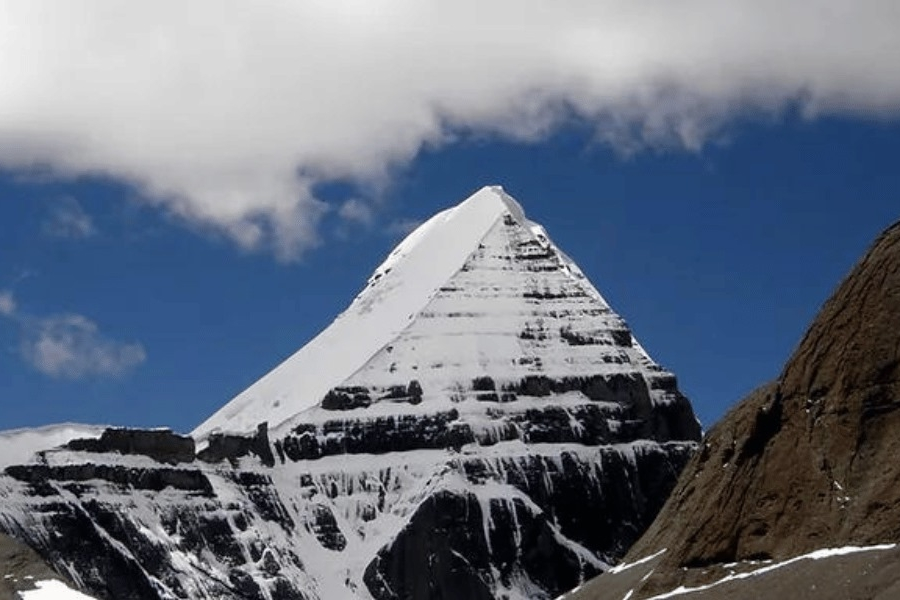
- During the Inner Parikrama, the Eastern Face of Mount Kailash is visible from a distance.
- The Eastern Face is believed to be made of crystal and is the most mysterious face of Mount Kailash.
- Gauri Kund, located at the East Face of Mount Kailash, is connected to Hinduism as it is where Lord Ganesha’s human face fell after a fierce punishment from his father, Lord Shiva.
- Parikrama offers opportunities to explore Dolma La Pass and Gauri Kund.
To witness the magnificence of Mount Kailash’s four faces, make a pledge to yourself to go on the Kailash Mansarovar Yatra at least once. You may also soar over the breathtaking sights of Mount Kailash with our exclusive Kailash Mansarovar Aerial Darshan.
My Experience at Mount Kailash
Visiting Kailash was unlike any other journey I had experienced. When I first saw the mountain, I had an overpowering sensation of serenity, as if time had slowed down. The walk was physically demanding—the rough paths, unpredictable weather, and thin air strained every ounce of my strength. However, with each stride, my faith became greater.
When I eventually got up close to the sacred mountain, it was more than simply a sight to see; it was an experience that pierced my soul. The stillness of the site spoke louder than words, and the aura around Kailash reminded me why thousands of pilgrims come here despite the difficulties.
For me, it was more than just a voyage; it was an inward one. A reminder that sometimes the most difficult journeys lead to the most heavenly outcomes.
Why Kailash is Truly Sacred
Mount Kailash is believed to be Lord Shiva’s residence and is revered in Hinduism, Buddhism, Jainism, and Bon. Pilgrims believe that completing the Kailash Parikrama (circumambulation) purifies the soul of sins and brings spiritual emancipation.
Standing there, I felt linked not just to my personal religion, but also to the innumerable searchers who, over generations, had walked the same route with hope.