
 by
by We’ve made almost every Maharashtra hill stations road trip mistakes possible. Seriously. From getting stuck on a flooded road near Lonavala to booking a “lakeview” resort that overlooked a dried-up pond, Ketan and I have been there. And the frustrating part? Most of these problems were completely avoidable.
Here’s what we learned after countless weekend drives from Pune to Mahabaleshwar, Matheran, Panchgani, and everywhere in between. These aren’t generic travel tips. They’re the specific things that went wrong for us, and the fixes we now use every single trip.

Mistake 1: Starting Your Drive at the Wrong Time
This sounds basic. It isn’t.
Most couples think leaving early means beating traffic. So they set an alarm for 5 AM, rush through packing, and hit the road by 6. Then they sit in bumper-to-bumper traffic at Khandala because everyone else had the same brilliant idea.
We did this on our first Lonavala trip. Left Pune at 6:15 AM on a Saturday. Reached Lonavala at 10:30 AM. The drive should’ve taken 90 minutes. We spent over four hours crawling through traffic, arguing about whose idea it was to leave “early,” and reaching our resort too exhausted to enjoy anything.
The fix isn’t leaving earlier. It’s leaving much earlier or much later.
If you’re heading to popular spots like Lonavala, Mahabaleshwar, or Matheran on a weekend, you’ve got two good windows. Leave before 5 AM — and I mean wheels rolling by 4:45 AM — or wait until after 10 AM when the first wave of traffic has passed.
Here’s what works for us now: we pack the car the night before. Everything. Snacks, water bottles, phone chargers, clothes. We wake up, brush our teeth, grab coffee in a thermos, and leave. No morning rush. No forgetting half our stuff because we’re groggy.
The 4:45 AM start gives you empty roads, cool morning air, and you reach your destination by breakfast time. You get the entire day. The resort check-in might not be ready, but most places let you use the pool or common areas while you wait.
The late start works too, but differently. You leave after 10 AM, stop for a proper breakfast somewhere nice, reach by early afternoon. Check-in is ready. You unpack, rest a bit, then head out for sunset. It’s more relaxed. Less rushed.
What doesn’t work is the 6-8 AM window. That’s when everyone else is on the road. You’ll sit in traffic, burn fuel, and start your romantic getaway annoyed with each other.
Mistake 2: Trusting Google Maps Blindly in Hill Areas
Google Maps is great. Until it isn’t.
The moment you leave the highway and start climbing into hill stations, Maps stops being reliable. We learned this near Bedse Caves. Maps suggested a shortcut through a village road. The road existed, technically. It was also barely wide enough for one car, unpaved, and included a section where we had to cross a small stream.
Ketan was driving. I was navigating. We both kept saying “Maps says this is the route” like that made it okay. It took us 45 minutes to cover 8 kilometers. Our car got scratched by overhanging branches. We terrified a herd of goats. And when we finally reached the main road, a local guy laughed and said, “Why didn’t you just take the proper route?”
Hill station driving safety means not assuming the fastest route on the app is the safest route in reality.
Here’s how we handle navigation now. Before the trip, we check the route on Maps. Then we cross-check it on at least one other source — preferably a recent YouTube video of someone actually driving that route. Sounds excessive, but it works. You’ll immediately see if that “shortcut” involves dirt roads, steep climbs, or areas prone to landslides during monsoon.
We also ask locals. Not about the destination — they know we’re tourists. We ask about the road. “Is the Panchgani route via Wai clear?” “Any construction between Satara and Mahabaleshwar?” Simple questions. You get real-time information that no app has.
And if a route looks sketchy on the screen — lots of sharp turns, no clear road marking, passes through dense forest — we don’t take it. Doesn’t matter if it saves 20 minutes. The couple travel tips Maharashtra locals give us have saved hours of backtracking.
One more thing. Download offline maps before you leave. Mobile networks get patchy once you’re deep in the hills. We use Maps.me as a backup. It’s ugly, but it works without data.
Mistake 3: Booking Accommodation Based Only on Photos
This is the mistake that hurts the most. Because you don’t discover it until you’ve already paid and driven three hours.
We booked a resort near Panchgani once. The photos were gorgeous. Infinity pool overlooking the valley. Cottages with floor-to-ceiling windows. “Romantic getaway planning” done, we thought. Reality? The pool was under maintenance. The valley view was blocked by a newly constructed building. And the cottage had windows, sure, but they faced the parking lot.
Here’s the thing about hill station resorts. Everyone’s using the same playbook. Shoot photos at golden hour. Use wide-angle lenses. Show the one nice corner and crop out the rest. We’re not saying they’re lying, but they’re definitely not telling the whole truth.
Now we do this. First, we check Google Reviews. Not the rating — anyone can pay for a 4.5-star average. We read the one-star and two-star reviews. What are people actually complaining about? If multiple reviews mention the same issue — say, bad food or rude staff — we take it seriously.
Second, we look for reviews with recent photos. User-uploaded photos show you the real property. The rooms when they’re not staged. The view from the balcony as it actually is. The food as it’s actually served.
Third, we check the review dates. A resort with 200 five-star reviews sounds great until you notice they’re all from 2022-2023 and all the 2025-2026 reviews are one or two stars. Something changed. Management, maintenance, ownership. Doesn’t matter what. It’s not the same place anymore.
Fourth, we call them. Yes, actually call. We ask specific questions. “Is the pool open this weekend?” “Which rooms have the valley view?” “What time is checkout?” The way they answer tells you a lot. If they’re evasive or annoyed by basic questions, that’s your sign.
And here’s a common road trip errors thing we see all the time: couples book the cheapest room thinking all rooms are similar. They’re not. Hill resorts have massive variation. One room faces the valley. Another faces the generator shed. One has a balcony. Another has a window that doesn’t open. Pay the extra ₹800-1200 for the better room. You’re there for two days. It’s worth it.
Mistake 4: Underestimating Weather and Road Conditions
Maharashtra’s hill stations aren’t the Himalayas. That makes people casual about checking weather and road conditions. Big mistake.
We drove to Mahabaleshwar in July 2024. It was monsoon, obviously, but we’d done monsoon trips before. No big deal, we thought. Then it started raining. Properly raining. The kind where your wipers on full speed still can’t keep up. Visibility dropped to maybe 20 meters. The road was slick. And somewhere near Pratapgad, we hit a patch of road where water was flowing across the tarmac.
Ketan slowed down to a crawl. Cars behind us were honking. We didn’t care. That water could’ve been ankle-deep or knee-deep. We couldn’t tell. We crossed it slowly, felt the car wobble slightly, and decided that was enough adventure. We turned back.
The whole trip wasted because we didn’t check the weather properly. Not just “will it rain” but “how much will it rain, and will that make the roads dangerous.”
Here’s our weather and road check process now, especially during monsoon. We check rainfall forecasts for the exact dates we’re traveling. Not just the destination, but the route. Heavy rain between Pune and Lonavala doesn’t matter if you’re going to Matheran, but it matters a lot if you’re going to Lonavala.
We check the India Meteorological Department website. It’s not pretty, but it’s accurate. If they’ve issued a heavy rain warning for Sahyadri ranges, we postpone. Simple.
We also check social media and travel groups. Someone’s always posting real-time updates. “Lonavala road clear as of 8 AM” or “avoid Tamhini Ghat today, landslide near XYZ point.” These updates are gold. More useful than any official source.
For winter trips (November to February), we check fog conditions. Mornings can get seriously foggy around Panchgani and Mahabaleshwar. Driving through dense fog on a hill road with sharp turns is not romantic. It’s terrifying.
And if you’re traveling during or just after monsoon, assume some roads will have potholes. Assume some sections will have minor landslides cleared to the side. Assume it’ll take longer than Maps says. Plan for that. Don’t book a resort activity at 11 AM if you’re leaving Pune at 8 AM. You’ll be rushing, stressed, and annoyed.
Mistake 5: Not Planning for Food and Fuel Stops
This sounds obvious until you’re hungry, the fuel light is on, and there’s no petrol pump or decent restaurant for 30 kilometers.
We ran into this between Satara and Mahabaleshwar. We’d had breakfast before leaving Pune, figured we’d grab lunch at the resort. But the drive took longer than expected (see Mistake 1). By 1 PM, we were starving. We stopped at a roadside dhaba. The food was… okay. We ate because we had to, not because we wanted to.
Then, 20 minutes from Mahabaleshwar, the low fuel warning came on. Ketan was sure we’d make it. I wasn’t. We spent the last stretch arguing about whether we should’ve filled up in Satara. Spoiler: we should’ve.
Here’s how we handle food and fuel now. We identify fuel stations along the route before we leave. We use Google Maps, but we also ask in travel groups. Some pumps are listed on Maps but closed. Some are out of fuel during peak season. Knowing which pumps are reliable saves you from gambling with your fuel gauge.
We fill up before entering hill areas. Even if the tank is half full. Hill driving uses more fuel than plains driving because you’re constantly accelerating uphill. The fuel efficiency you get on the highway doesn’t apply here.
For food, we pack our own snacks for the drive. Sandwiches, fruit, energy bars, plenty of water. This isn’t about saving money. It’s about not being forced to eat at the only available dhaba when you’re starving.
But we also plan one proper food stop. A place we actually want to try. Could be a famous misal spot in Satara, a strawberry farm café near Mahabaleshwar, or a Parsi dhaba on the old Mumbai-Pune highway. We build that into the trip timing. It becomes part of the experience, not a desperate refueling stop.
And here’s a couple travel tips Maharashtra thing Samprita insists on: always carry an extra bottle of drinking water in the car. Not the one you’re currently drinking from. An extra one. You’d be surprised how often that’s saved us. Overheating car, unexpected delay, or just running out faster than we thought.
One more: check your resort’s meal timings before you arrive. Some places stop serving lunch at 2 PM sharp. If you’re reaching at 2:30 PM expecting lunch, you’re not getting it. You’ll end up eating Maggi from their small café menu or driving back down to find a restaurant, tired and annoyed.
What We Do Now Before Every Maharashtra Hill Station Road Trip
These aren’t rules. They’re just things we do because they work.
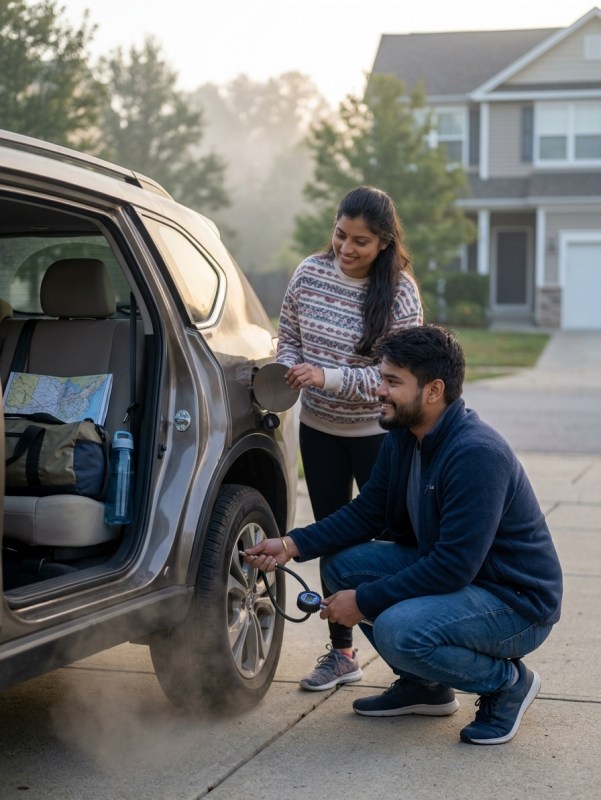
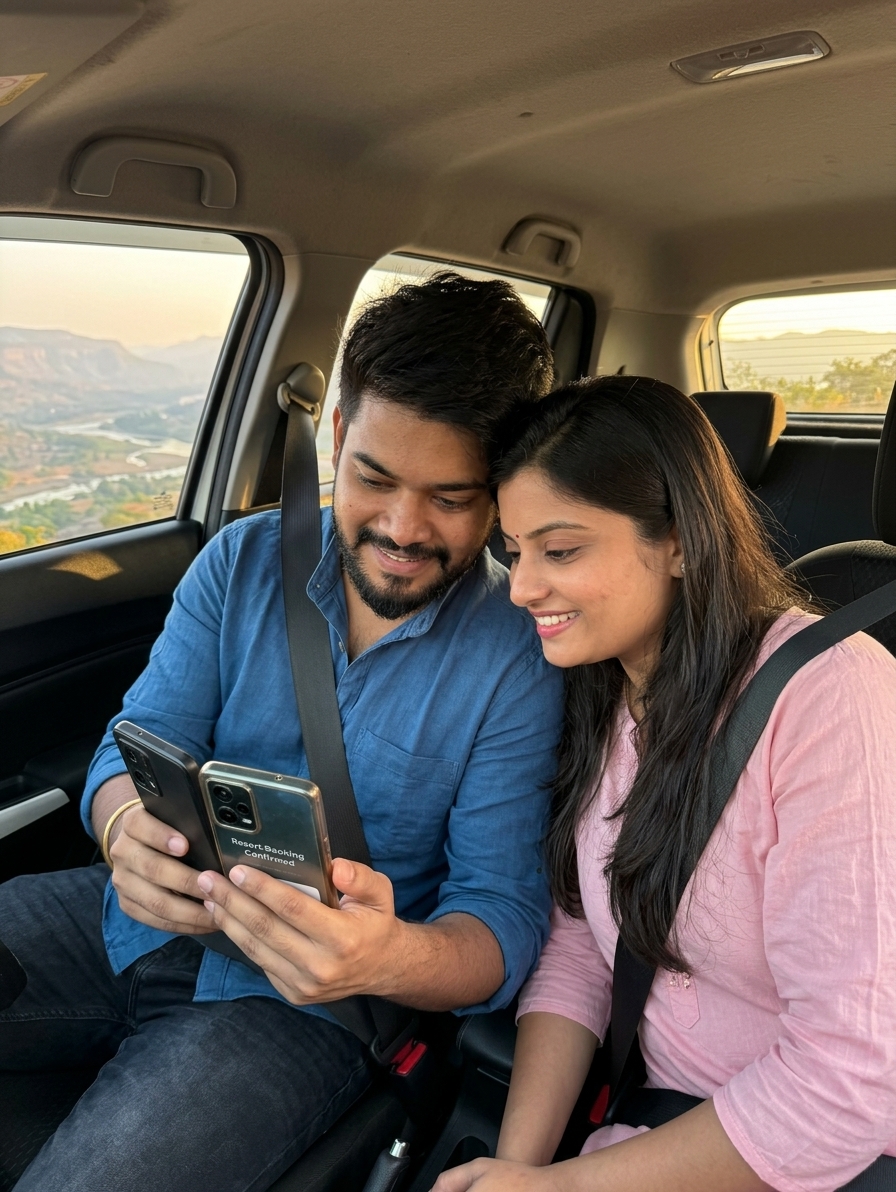
Night before: pack the car completely. Check tire pressure. Fill fuel. Charge all devices. Keep the route and resort confirmation downloaded offline.
Morning of: wake up, minimal fuss, and leave. We don’t cook breakfast or shower for 30 minutes. We do that the night before or we grab something on the road.
During the drive: one person drives, the other navigates and manages music. We don’t switch roles mid-trip. Sounds small, but it reduces friction. We know who’s responsible for what.
Food and breaks: we stop when we’re actually tired or hungry, not because it’s “time” to stop. Forced breaks when you’re not tired just add time.
Communication: if something feels off — the route, the weather, the driving — we say it. We’ve learned that ignoring a gut feeling to avoid an argument usually leads to a bigger argument later.
And the big one: we stay flexible. If the original plan isn’t working, we change it. We’ve turned back. We’ve switched destinations mid-drive. We’ve checked into a different resort than the one we booked because the first one was terrible and we didn’t want to waste our weekend being polite about it.
The goal isn’t a perfect trip. It’s a trip where you actually enjoy each other’s company, see something beautiful, eat something good, and come back without a list of things that went wrong.
Why These Common Road Trip Errors Matter More for Couples
Solo travelers and groups have different dynamics. If you’re traveling solo, you make all the calls. If you’re in a group, decisions get distributed and blamed collectively. But couples? Every decision is joint. Every mistake reflects on both of you. Every moment of frustration can snowball.
We’ve seen it happen. A wrong turn becomes “you said to take this route.” A bad resort becomes “you booked this place.” Running out of fuel becomes “I told you to fill up earlier.” Suddenly you’re not on a romantic getaway. You’re on a blame assignment exercise.
That’s why romantic getaway planning isn’t about candles and rose petals. It’s about eliminating the stupid, avoidable problems that kill the mood. Traffic, bad weather, shady resorts, getting lost — these aren’t minor inconveniences. They’re romance killers.
When we started traveling together, we thought spontaneity was romantic. Just pack and go. No planning. No structure. It wasn’t romantic. It was stressful. We argued more. Enjoyed less. Came back tired instead of refreshed.
Now we plan the logistics ruthlessly. Timing, route, backup plans, food, fuel. Everything. That frees us up to actually be spontaneous about the fun stuff. Which trek to do. Which café to try. Whether to wake up for sunrise or sleep in.
The romantic part isn’t the lack of planning. It’s the lack of stress. When you’re not worried about where you’ll eat or whether you’ll have fuel or if the resort is a scam, you can actually focus on each other.
That’s the real couple travel tips Maharashtra experience teaches you. The best trips aren’t the ones where nothing goes wrong. They’re the ones where you planned well enough that the small things that do go wrong don’t matter.
Frequently Asked Questions
What’s the best time to start a road trip to Maharashtra hill stations on weekends?
Leave before 4:45 AM or after 10 AM on weekends. The 6-8 AM window puts you in peak traffic. Early starts get you empty roads and a full day at your destination. Late starts let you avoid the rush and reach when check-in is ready.
How do I choose a safe route for hill station drives in Maharashtra?
Cross-check Google Maps routes with recent YouTube drive videos and ask locals about current road conditions. Download offline maps as backup. Avoid shortcuts through unmarked village roads, especially during or after monsoon.
Should I book the cheapest room at a hill station resort?
No. Room quality varies massively in hill resorts. The cheapest rooms often face parking lots or have no view. Pay ₹800-1200 extra for valley-view or better-located rooms. You’re there for two days — the upgrade is worth it.
When should I fuel up during a Maharashtra hill station road trip?
Fill up before entering hill areas, even if your tank is half full. Hill driving uses more fuel than highway driving. Identify reliable fuel stations along your route beforehand — some listed pumps are closed or out of fuel during peak season.
How can I verify if a resort’s photos match reality?
Read one-star and two-star Google Reviews for specific complaints. Check user-uploaded photos in reviews, not promotional images. Verify review dates — recent negative reviews outweigh old positive ones. Call the resort and ask specific questions about amenities and room locations.
Ready to Plan Your Next Hill Station Road Trip the Right Way?
Look, we’re still learning. Every trip teaches us something new. But these five Maharashtra hill stations road trip mistakes cover about 80% of what typically goes wrong for couples.
You don’t need a fancy car or a huge budget. You need a decent plan, realistic expectations, and the willingness to adjust when things don’t go as expected.
At Musafir Couple, we share these experiences because we’ve lived them. The good drives, the terrible ones, the ones that started badly and ended beautifully. If you want more honest reviews, actual costs, and real couple travel experiences from Maharashtra and beyond, follow us on YouTube. We’re Ketan and Samprita, and we’re figuring this out one road trip at a time.
Plan better. Argue less. Enjoy more. That’s the goal.