

 by
by We were stuck in Baga Beach traffic at 11 AM on a Sunday. Bikes everywhere. Beach shacks blasting the same playlist. Tourists haggling over sunbeds. Samprita looked at me and said, “This can’t be the only Goa.”
It wasn’t.
The next morning, we asked our homestay host in Palolem — not Google, not Instagram — where she goes when she wants to actually sit by the water. She paused. Then she mentioned three names we’d never heard of. One required a short trek. Another had no cell signal. The third didn’t even have a proper parking lot.
We visited all three. None were empty, but none felt like Calangute either. Real families. Quiet conversations. Actual fishing boats.
That’s when we realized most travellers never find the hidden beaches in Goa because they’re searching in the wrong places. They’re not on Top 10 lists. They’re not tagged on every reel. And locals prefer it that way.
But here’s what we learned after spending weeks talking to fishermen, homestay owners, and couples who’ve lived in Goa for decades — these beaches exist, they’re accessible, and once you know how locals pick them, you’ll stop visiting the crowded ones.
Why the Popular Beaches Don’t Work for Couples Anymore
Baga and Calangute weren’t always this packed. Ten years ago, they were the off-beat beaches Goa offered to budget travellers. Now they’re entry points for tour buses.
The shift happened around 2018. Cheap flights from North India. Weekend packages under ₹8,000 for two. Instagram grew. Every sunset spot got geo-tagged. The beaches that once felt hidden became checklist items.
Most blogs still recommend Palolem as a “quiet escape.” It’s not. It’s beautiful, sure. But between November and February, you’ll share that beauty with 300 other people at any given time.
We’re not saying skip the famous beaches entirely. We’re saying if you want the Goa that locals experience, you’ll need to go where tour operators don’t take groups. Where beach shacks aren’t branded. Where the road getting there makes you question your decision twice.
That’s the Goa we’re covering here.
Cola Beach – The One That Still Feels Untouched
Cola Beach sits between Agonda and Palolem, but most people miss it because there’s no proper signboard from the main road. You turn off NH66 near Khola village, follow a narrow lane past a few houses, and suddenly you’re staring at a lagoon-backed beach that looks like it wandered in from Thailand.
Ketan thought the road was a mistake. I thought we’d end up at someone’s backyard. Neither happened. We reached a small dirt parking area — no charge, no attendant — and walked down.
The beach is split into two sections. The main coastline where the Arabian Sea meets golden sand. And a freshwater lagoon just behind it, separated by a thin strip of land. Locals swim in the lagoon. Tourists wade into the sea. Both are stunning.
What makes Cola one of the best local beaches Goa has is the absence of infrastructure. There are two small beach huts offering basic food — fish thali, coconut water, beer. No sunbeds for rent. No water sports. No loud music.
We met a Goan family who’d been coming here every Sunday for five years. They bring their own mat, pack lunch, and spend the afternoon by the lagoon. When we asked why they don’t go to Palolem, the father laughed. “Palolem is for guests. This is for us.”
Access: 8 km from Agonda. Reachable by car or scooter. The last 500 meters is a dirt track — manageable but bumpy. Park near the coconut grove and walk 2 minutes down.
Cost: Zero entry. ₹150–₹200 for a meal at the shacks. Carry your own mat or towel.
Worth it? Absolutely. Especially if you’re tired of beaches that feel like open-air malls.
Kakolem Beach – The Trek You Won’t Regret
Kakolem doesn’t let you drive up and park. You earn it.
From the village of Cabo de Rama, there’s a steep walking trail through dense vegetation. It’s not a formal path. It’s not signposted. You’ll rely on word-of-mouth or a local guide. The descent takes 15–20 minutes. The climb back up takes 25 and leaves you sweating.
But once you’re down, you’ll understand why locals guard this secret beaches Goa spot so carefully.
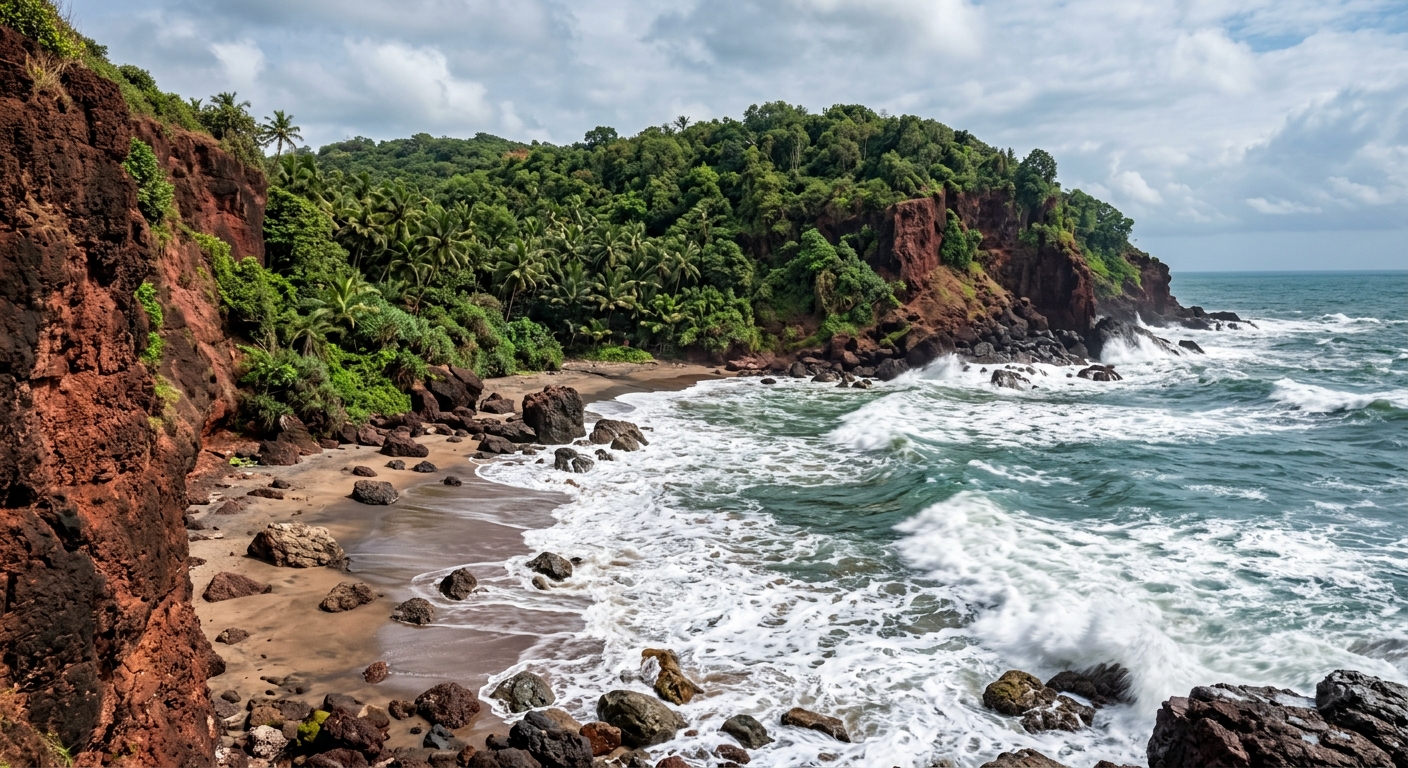
The beach is flanked by red cliffs on both sides. The sand is darker, almost golden-brown. The water is clean but rough — locals don’t recommend swimming unless you’re confident. We saw two families when we visited on a Thursday afternoon. That’s it.
One thing nobody mentions online — there are no facilities. No shacks. No toilets. No fresh water. You bring everything in and carry everything out. That single fact keeps the crowds away.
We met a couple from Margao who hike down twice a month. They bring a cooler, a Bluetooth speaker on low volume, and a trash bag. “If you take care of the beach, it takes care of you,” the guy told us. He’d been visiting for 11 years.
Access: From Cabo de Rama Fort, ask locals for “Tiger Beach” — that’s the old name. Follow the trail downhill. Wear shoes with grip. The return climb is no joke.
Cost: Free. Bring your own food, water, and a trash bag.
Worth it? Yes, but only if you’re okay with effort. This isn’t a lazy beach day.
Butterfly Beach – Best Reached by Boat
Butterfly Beach is technically accessible by foot, but the trail from Palolem is tricky, overgrown, and takes 45 minutes through dense forest. Most locals skip the hike and take a boat.
Fishermen near Palolem Beach offer morning trips to Butterfly Beach for ₹300–₹500 per person, depending on group size. The ride takes 15 minutes. They drop you off, give you two hours, and pick you up. Some include snorkelling if you ask.
The beach itself is small — maybe 200 meters of sand tucked between rocks and jungle. The name comes from the butterflies that gather near the rocks in the early morning. We didn’t see clouds of them like some blogs claim, but we did spot a few around 7 AM.
What stood out wasn’t the butterflies. It was the lack of noise. No road nearby. No shacks. Just waves, birds, and the occasional boat engine in the distance.
A local boat operator we spoke to — his family has been fishing this stretch for three generations — said tourist numbers have grown in the last two years, but it’s still one of the off-beat beaches Goa locals visit when they want total quiet. “No one builds here. No one will. It’s protected coastline,” he said.
Access: Boat from Palolem or Agonda (₹300–₹500 return). Or trek from Palolem — ask a local to show you the trail start.
Cost: Boat ride only. No entry, no facilities. Bring snacks and water.
Worth it? For the boat ride alone, yes. For the peace, absolutely.
Galjibag Beach – The Turtle Nesting Ground
Galjibag sits near the Karnataka border, which already puts it outside most people’s Goa circuit. It’s wide, clean, and almost completely empty on weekdays.
The reason it stays quiet isn’t just location. It’s a protected turtle nesting site. Olive Ridley turtles come ashore between October and March to lay eggs. The Forest Department monitors the beach, and during nesting season, sections are cordoned off.
That protection keeps commercial activity low. There are no permanent shacks. No resorts. Just a small fishing village at one end and open sand for most of the stretch.
We visited on a Saturday in January. Four families. One couple. A few fishermen mending nets. The vibe was calm, almost sleepy. Samprita walked the entire beach end-to-end in 20 minutes.
A local teacher we spoke to — she brings her students here every year to learn about turtle conservation — said Galjibag is one of the last quiet beaches Goa crowds haven’t ruined. “Once people realize how close it is to Palolem, that might change. But for now, it’s ours.”
Access: 14 km from Palolem. Well-connected by road. You can drive right up to the beach. Parking is informal, near the fishing area.
Cost: Free. One small shack operates sporadically — if it’s open, expect ₹100–₹150 for tea and snacks.
Worth it? Yes, especially if you want space and don’t need Instagram drama.

Kalacha Beach – Sweetwater Lagoon Combo
Kalacha is the lesser-known neighbour of Arambol. Most people visit Arambol, see the crowds, and leave. Locals walk 10 minutes north to Kalacha.
The beach connects to a freshwater lagoon locals call “Sweet Lake.” The lake sits just inland, surrounded by palms and low vegetation. You can swim in both the sea and the lake in the same visit.
What we loved about Kalacha wasn’t just the dual-water setup. It was the lack of commercial push. A few small shacks serve food — Goan fish curry, rice, basic snacks. No one hassles you to rent a chair. No one’s selling henna tattoos or sarongs.
We met a Goan woman who grew up near Arambol. She stopped going to Arambol Beach five years ago. Now she brings her kids to Kalacha every Sunday. “My children can run. I can sit. No one bothers us,” she said.
The lagoon is shallow and warm — ideal for kids or anyone who finds the sea intimidating. Locals bathe there in the mornings. Tourists usually show up after 10 AM.
Access: Walk north from Arambol Beach for 10–15 minutes along the shore. Or drive to Kalacha village and park near the shacks.
Cost: Free. Food at shacks runs ₹100–₹250 depending on what you order.
Worth it? If you’re staying near Arambol, this is a no-brainer.
How Locals Actually Pick a Beach
After a month in Goa, we noticed a pattern. Locals don’t choose beaches the way tourists do. They don’t care about “Top 10” rankings or sunset photo angles.
They ask three questions. Can I get there without traffic? Will my family feel safe? Can I sit without spending ₹500 on a sunbed?
Most of the best local beaches Goa offers fail the Instagram test. They don’t have picture-perfect shacks. The sand isn’t always white. There’s no DJ at sunset.
But they pass the real test. You can breathe. You can hear the water. You can leave without feeling like you just survived a carnival.
The beaches we’ve listed here aren’t completely unknown. Locals visit them. A few travellers find them by accident. But they’re not on the bus-tour circuit, and that’s the point.
What You Need to Know Before You Go
Most hidden beaches in Goa lack basic facilities. That’s not a bug. It’s a feature. It’s what keeps them hidden.
Bring water, snacks, a towel, and sunscreen. Carry a trash bag — if locals see you cleaning up after yourself, they’re more likely to share tips on other spots.
Some beaches, like Kakolem, require physical effort. Don’t attempt them in flip-flops or after a heavy meal. Wear real shoes. Start early before the heat peaks.
Cell signal is weak or absent at several of these locations. Download offline maps. Tell someone where you’re going.
If you’re hiring a boat, confirm the return time upfront. We’ve heard stories of tourists getting stranded because they assumed the boatman would “just know” when to come back.
And here’s the part most blogs won’t say — locals tolerate tourists at these beaches because tourists have mostly been respectful. If that changes, access changes. We’ve already seen it happen at a few spots near Palolem.
Our Honest Take After Visiting All of Them
We’ve now been to Baga, Calangute, Anjuna, Palolem, and all five beaches listed here. The difference isn’t subtle.
The famous beaches are convenient. You can park, eat, drink, swim, and leave without planning. They’re fine if you’re short on time or visiting Goa for the first time.
But if you’ve done Goa before — or if you’re the kind of couple that prefers a quiet morning over a loud party — the secret beaches Goa locals visit will reset your expectation of what a beach day should feel like.
Cola Beach became our regular spot. We went back three times in two weeks. Kakolem was the most rewarding, but also the most exhausting. Butterfly Beach felt like a mini adventure. Galjibag and Kalacha were perfect for lazy Sundays when we didn’t want to think too hard.
None of them are perfect. None of them are luxury experiences. But all of them reminded us why we started travelling in the first place — to find places that don’t feel packaged.
Frequently Asked Questions
Which hidden beach in Goa is best for couples?
Cola Beach. It’s private without being isolated, has basic food available, and the lagoon-beach combo gives you two environments in one visit. Most couples we met there were repeat visitors.
Can you visit these beaches during monsoon?
Not recommended. Most off-beat beaches Goa locals visit become inaccessible or unsafe between June and September due to rough seas, slippery trails, and limited boat services. Visit between October and March.
Do you need a guide to reach Kakolem Beach?
Not mandatory, but helpful. The trail isn’t marked, and first-timers often take wrong turns. Locals near Cabo de Rama Fort offer to guide for ₹200–₹300. If you’re confident with directions, ask a shopkeeper to point you toward the trailhead.
Are these beaches safe for solo female travellers?
Yes, during daylight hours. Most are frequented by local families, which adds a layer of natural safety. Avoid visiting alone late in the evening, especially beaches without nearby villages like Kakolem or Butterfly Beach.
Plan Your Visit to Goa’s Real Beaches with Musafir Couple
If you want more honest reviews, real costs, and no-fluff travel tips across Goa and beyond, follow Musafir Couple on YouTube and Instagram. Ketan and Samprita share unscripted travel stories, hidden spot discoveries, and the kind of practical advice you won’t find in sponsored listicles — just two people exploring India one real experience at a time.
Planning your Goa trip and need help with routes, stays, or lesser-known gems? Reach out through the Musafir Couple social channels. We reply. We share. We don’t gatekeep.
Because the best travel tips don’t come from algorithms. They come from couples who’ve actually been there, gotten lost, asked locals, and figured it out — just like you’re about to.