
 by
by We sat in the car outside Bedse Caves around 11 AM, absolutely blown away by what we’d just seen — ancient rock-cut architecture, zero crowds, just silence and stone. Samprita looked at the map on her phone and said, “Karla Caves is only 18 kilometres away. Let’s just go.”
That short drive turned into one of the most unexpectedly educational road trips we’ve done around Pune. The route looks simple on Google Maps. The reality? It taught us more about Maharashtra’s lesser-known temple roads, village bypasses, and cave tourism infrastructure than any guidebook ever could.
Here’s exactly what that Bedse Caves to Karla Caves road trip looks like in 2026 — the actual road conditions, where to park without getting scammed, what you’ll pay to enter, and the small details that make the difference between a smooth drive and a frustrating one.
Why This 18-Kilometre Route Deserves Its Own Guide
Most travel content treats Bedse and Karla as separate destinations. You read one article about Bedse, another about Karla, and you’re left piecing together the logistics yourself. That’s exactly where confusion starts.
The truth? These two cave complexes work brilliantly as a half-day road trip combo. They’re close enough to cover in one morning, different enough in scale and energy to feel like distinct experiences, and connected by a route that shows you rural Maharashtra most tourists never see.
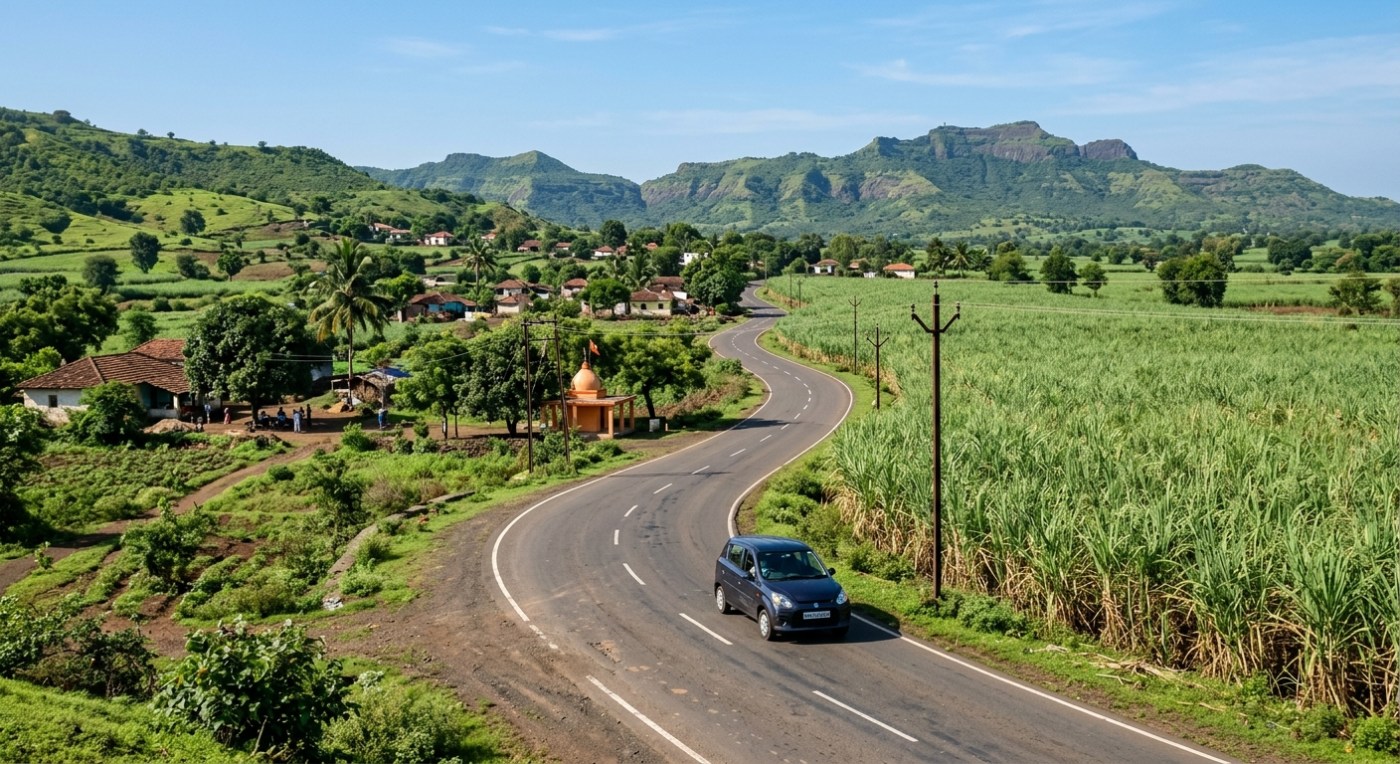
But the 18-kilometre distance is deceptive. It’s not a straight highway run. You’ll navigate village roads, cross through temple market areas, deal with sudden patches of terrible tarmac, and make at least one wrong turn if you’re relying only on GPS. We did exactly that. Ended up on a farm road that dead-ended near a sugarcane field. A local uncle on a motorcycle waved us back, laughing at what must be a daily sight during tourist season.
Musafir Couple has driven this route twice now — once during monsoon, once in late winter — and the conditions change dramatically based on season and time of day. What doesn’t change is how useful this little stretch is if you want to experience two stunning cave sites without the exhaustion of a full-day marathon.
The Exact Route from Bedse Caves to Karla Caves
Start from the Bedse Caves parking area. You’ll exit back onto the same approach road you came in on — a narrow two-lane stretch that winds downhill through scattered houses and farms. Drive carefully here. Locals park half their vehicles on the road, kids play near the edges, and the surface quality is inconsistent.
At the base of the hill, you’ll hit a T-junction. Turn left. This puts you on the Malavli-Kamshet road. For about 4 kilometres, the drive is pleasant — decent tarmac, light traffic, open views of the surrounding valleys. You’ll pass a few small eateries and a petrol pump on your right. This is your last reliable fuel stop if you’re running low, though it’s unlikely you’ll need it for such a short drive.
After about 6 kilometres, you’ll approach a market area. This is where GPS starts getting confused. It might tell you to turn right into what looks like a residential lane. Ignore it unless you enjoy tight squeezes between compound walls. Stay on the main road. It bends left and then right, passing through a busier section with vegetable stalls, a temple, and a school.
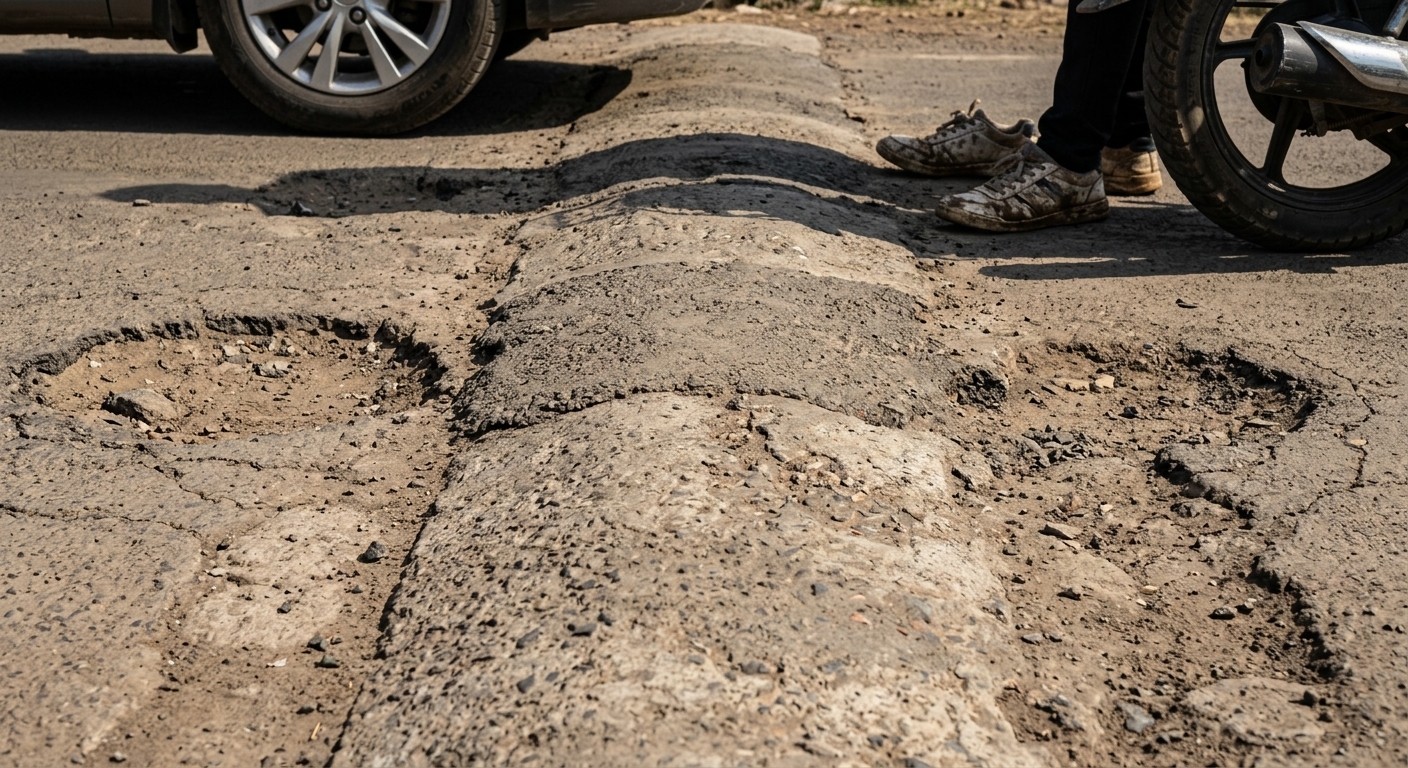
Around the 10-kilometre mark, you’ll see signboards for Karla Caves. Follow them. The route narrows again and becomes more winding. Some stretches have potholes that survive year after year, seemingly immune to repair. Speed breakers appear without warning, often unmarked. We scraped our car’s underside on one. Not badly, but enough to make Samprita wince.
The final stretch climbs gently upward. You’ll see shops selling religious offerings, small dhabas, and parking touts standing in the middle of the road waving you toward their preferred lots. Don’t commit to anything yet. Drive all the way to the official parking zone near the cave entrance. It’s clearer, better organized, and cheaper.
Total driving time? About 35 to 45 minutes if you’re driving cautiously and stop once to check directions or grab a bottle of water.
Road Conditions: What Your Car Needs to Handle
Let’s be direct. You don’t need a 4×4 or an SUV for the Bedse Caves to Karla Caves road trip. We’ve done it in a regular hatchback. But you do need to pay attention.
The road quality is inconsistent. Sections that look newly paved suddenly give way to stretches that haven’t been touched in years. During monsoon, some low-lying areas accumulate water. Not flooded, but enough to slow you down. In summer, dust clouds follow you through the village sections.
Ground clearance matters more than engine power. If your car sits low, you’ll need to approach speed breakers at an angle and drive slowly over broken patches. We watched a sedan with a low front bumper scrape twice on the same stretch. The driver was clearly frustrated.
Traffic is usually light, except on weekends and public holidays when both caves see higher footfall. Then you’re competing for space with tour buses, tempo travellers, and groups of Royal Enfield riders who treat the route as a warm-up run. Honking increases. Patience decreases.
One specific trouble spot: the market area around the 6-kilometre mark. It’s congested, narrow, and full of pedestrians who don’t expect tourist traffic. Drive slowly here. Use your mirrors. Don’t try to overtake aggressively. We saw a car and a motorcycle argue for five minutes over a minor scrape that could have been avoided with 10 seconds of patience.
The last 3 kilometres to Karla are winding. The gradient isn’t steep, but the curves are sharp enough that you can’t see oncoming traffic until you’re halfway through the turn. Honk before blind corners. It’s not paranoia — it’s common sense on narrow hill roads.
Bedse Caves Parking: Where to Leave Your Car
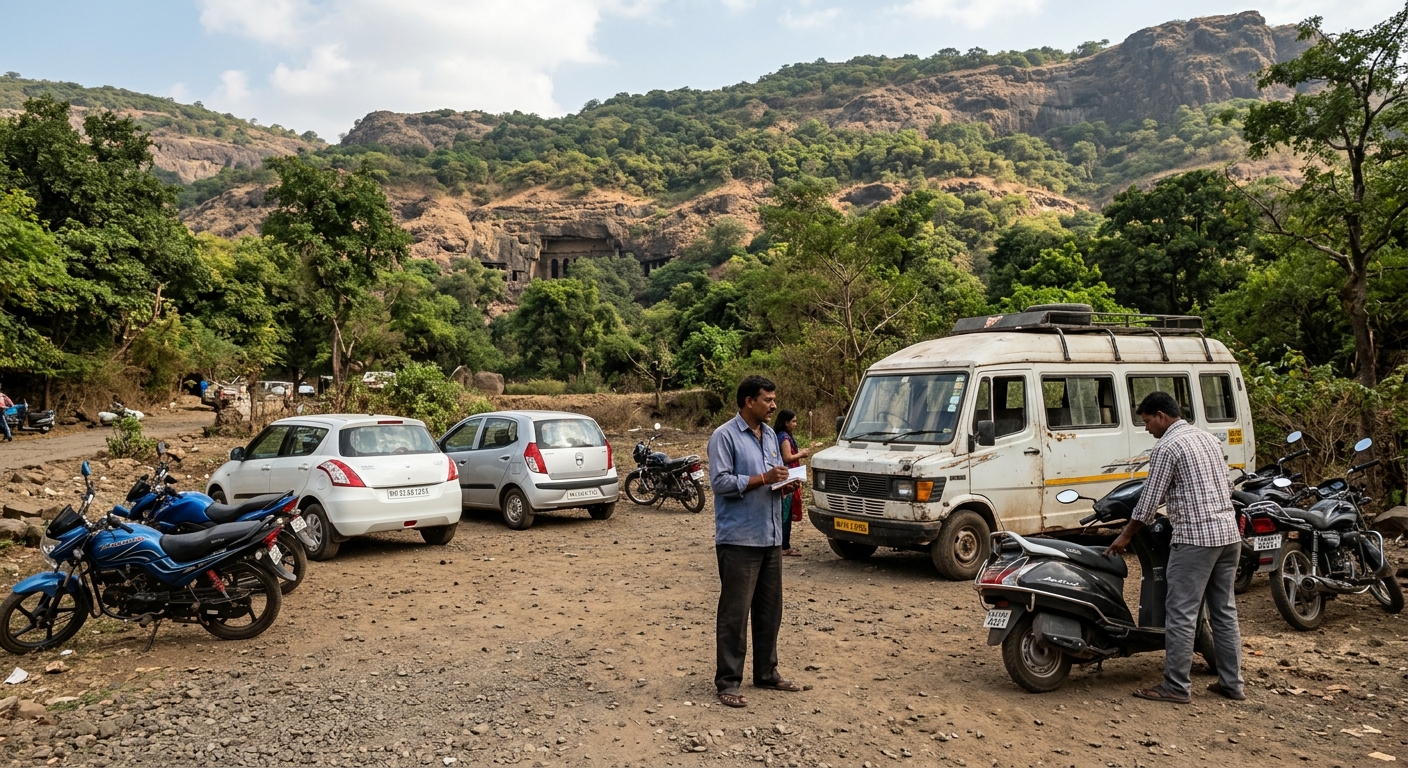
Bedse Caves parking is informal but functional. There’s no official multi-level lot or ticket booth. You park in a cleared area near the base of the hill, watched over by a couple of local guys who charge you ₹20 to ₹30 depending on vehicle size.
We’ve parked there twice. Both times, the car was safe. The attendants don’t issue tickets, but they remember faces and vehicles. When we returned after an hour, one of them nodded at our car and said, “Blue hatchback, right?” It’s that kind of low-key, trust-based system.
Park as close to the main cluster of vehicles as possible. Don’t leave valuables visible inside. Lock your doors. It’s a quiet area, and we’ve never heard of theft issues, but basic precautions cost nothing.
If you arrive early — before 9 AM — you’ll get a spot right near the trailhead. After 10:30, especially on weekends, you might park 50 meters further down the road. It’s not a long walk, but the slope is steep enough to make you glad you wore decent shoes.
One small frustration: the parking area isn’t shaded. In summer, your car will be an oven when you return. Crack a window slightly if you’re comfortable with it. We didn’t, and regretted it the moment we opened the door to a blast of trapped heat.
Karla Caves Parking: The Bigger, More Organized Setup
Karla Caves parking is a different experience. There’s a proper parking lot, signboards, and attendants in visible vests. You’ll pay ₹30 for a two-wheeler and ₹50 for a car. You get a token or a slip. Keep it. They check it when you leave.
The lot is paved and has marked spaces. It’s shaded in some sections, though not all. If you arrive before 11 AM, you’ll have plenty of options. After that, especially on Saturdays and Sundays, it fills up fast. We arrived at 12:30 once and had to park in an overflow area another 100 meters down the road. Not a dealbreaker, but not ideal either.
Here’s where the touts come in. As you approach Karla, you’ll see people waving you into private parking areas, promising “closer access” and “safe parking.” Ignore them. The official lot is closer, safer, and cheaper. The private spots charge ₹50 to ₹100 and leave your car in a dusty field with no real security.
One thing Musafir Couple learned the hard way: if you park in the official lot, walk back to the entrance and check where the actual cave complex is before you lock your car. The parking area is large, and the path to the caves isn’t always obvious. We wandered for 10 minutes the first time because we followed a group of tourists who were also lost.
Karla parking also has a small snack stall and a restroom block. The restrooms are basic but usable. If you need a bathroom break, this is your spot. Bedse doesn’t have public facilities.
Entry Fees for Bedse Caves and Karla Caves
Bedse Caves has no entry fee. Walk right in. It’s one of the last truly free ancient sites around Pune that hasn’t been commercialized yet. There’s no ticket counter, no gate, no security check. Just a trail and the caves.
This might change eventually. We’ve heard talk of the Archaeological Survey of India planning to formalize entry and charge a nominal fee, but as of early 2026, it’s still free.
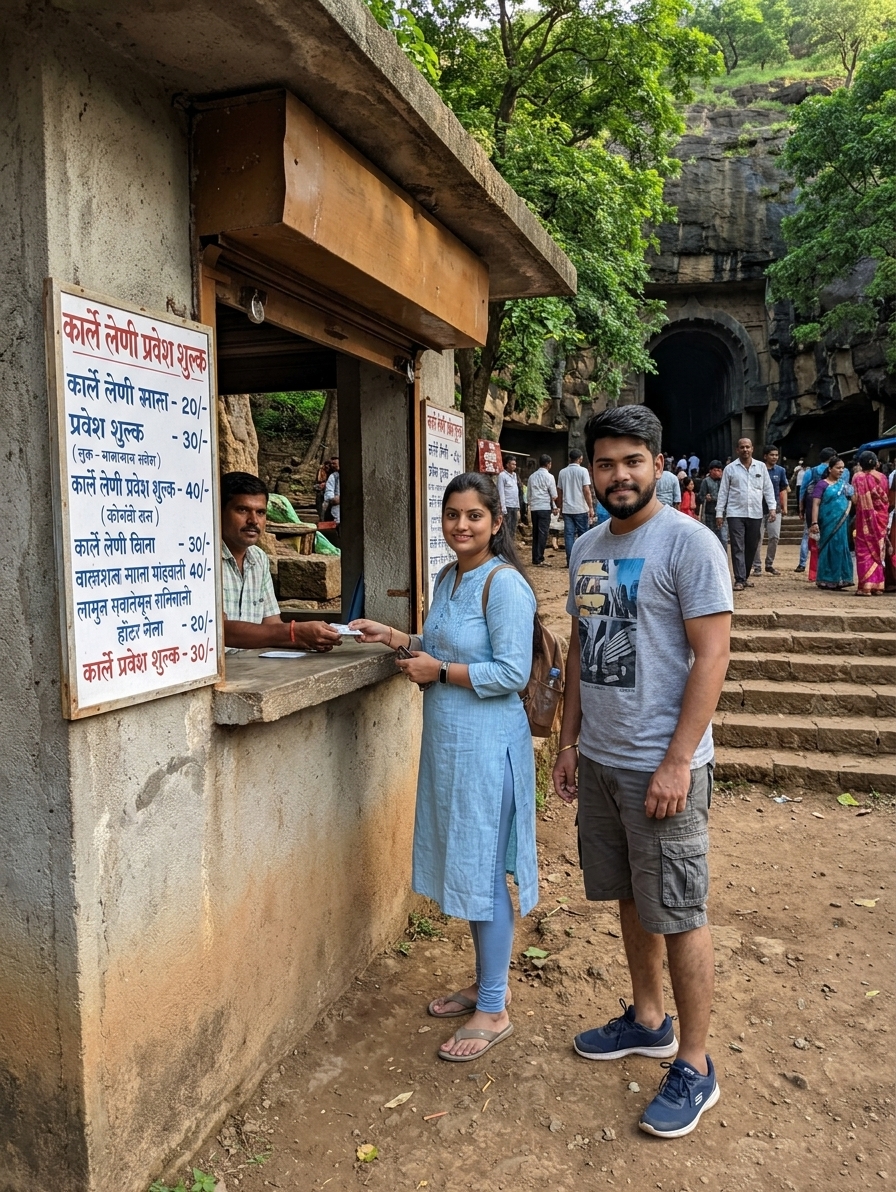
Karla Caves, on the other hand, charges ₹25 per person for Indian nationals. Foreigners pay ₹300. Children under 15 are free, though this isn’t enforced strictly. You buy tickets from a small counter near the parking lot. The ticket office opens at 9 AM and closes at 5:30 PM.
Photography inside the caves is technically not allowed without a permit, but this rule is inconsistently enforced. We saw people taking photos on their phones without issue. If you’re carrying a DSLR or a professional rig, you might be asked to pay a camera fee or asked to put it away. It depends on who’s on duty that day.
Keep your ticket with you throughout your visit. There’s a checkpoint at the entrance to the main cave, and they do check.
One thing to note: if you’re visiting both Bedse and Karla on the same day, you’re not paying for entry at Bedse, but you will pay at Karla. Budget ₹25 per person for Karla plus parking fees at both locations. Total out-of-pocket for two people in one car: roughly ₹150 to ₹180 including parking at both sites.
What the Drive Between the Caves Actually Shows You
This isn’t just a connector route. The 18 kilometres between Bedse and Karla gives you a glimpse of rural Maharashtra that most tourists skip entirely.
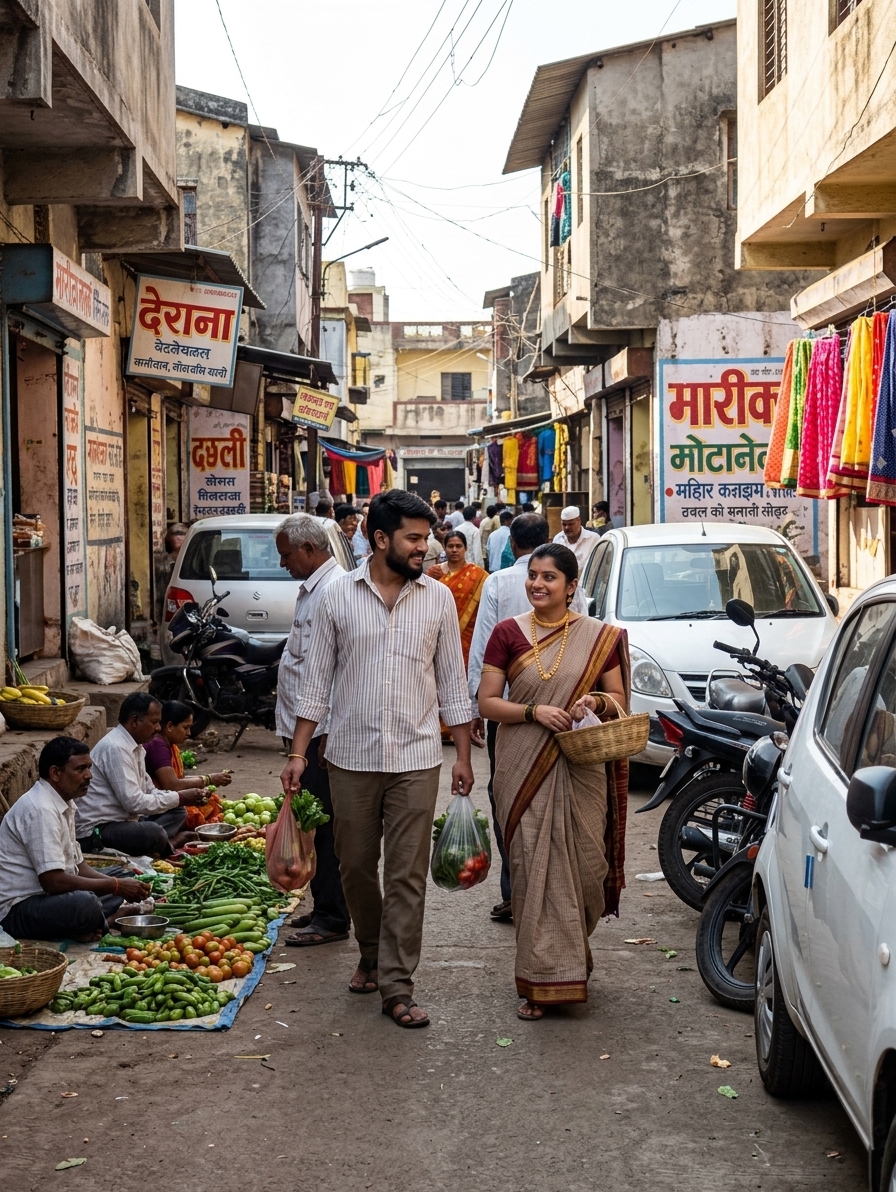
You’ll pass through villages where daily life unfolds on the roadside — women sorting vegetables, kids walking to school in crisp uniforms, elderly men sitting outside small shops playing cards. It’s unhurried, unpolished, and completely real.
The landscape shifts from open farmland to forested patches and back to farmland. In monsoon, the greens are almost aggressive in their intensity. In summer, dust softens everything into shades of beige and brown. We’ve driven this route in both seasons, and it feels like two different places.
There are roadside temples every few kilometres — small structures with fresh flowers and incense smoke, always tended, always in use. Samprita wanted to stop at one during our second trip. We did, for maybe five minutes. An older woman was lighting a diya. She smiled at us, said nothing, and went back to her ritual. It’s those tiny, unplanned moments that make the drive memorable.
You’ll also see sugarcane fields, especially closer to Karla. Depending on the season, you might see harvesting in progress — workers cutting stalks, loading them onto carts, tractors hauling loads down narrow farm roads. It’s hard work, and watching it unfold reminds you how much of India’s economy still runs on agriculture.
The villages themselves are a mix. Some houses are modern, with tiled roofs and painted gates. Others are older, with thatched roofs and mud walls. Satellite dishes sit next to hand pumps. It’s the visual contradiction that defines rural India in 2026 — caught between progress and tradition, not quite either.
Best Time of Day to Make This Drive
We recommend starting early. Leave Pune by 7 AM, reach Bedse by 8:30, spend an hour exploring the caves, and hit the road to Karla by 10:00. You’ll arrive at Karla around 10:45, explore at your own pace, and be done by 1 PM. Avoid the midday heat, avoid the weekend crowds, and you’re back home for lunch.
If you’re not a morning person, the next best window is late afternoon. Start around 3 PM. But here’s the catch — Karla Caves closes at 5:30 PM. You’ll feel rushed. The lighting inside the caves is also dimmer later in the day, and the market area outside gets chaotic as vendors pack up.
We made the mistake once of starting at 11 AM on a Saturday. Both caves were crowded. Parking at Karla was a mess. The drive between the two felt slower because of increased traffic. The whole experience was noticeably less enjoyable.
Monsoon months — June through September — are beautiful but tricky. The roads are slippery, visibility drops during heavy rain, and some low sections flood temporarily. If you’re confident driving in wet conditions, it’s stunning. If not, stick to the post-monsoon or winter months.
Winter — November through February — is ideal. Cool weather, clear skies, dry roads, fewer tourists. We’ve done the route in December, and it was perfect.
What Musafir Couple Wishes We Knew Before the First Trip
Carry water. There are no reliable stops between Bedse and Karla where you can buy bottled water. The small shops along the way may or may not be open, and their stock is unpredictable.
Wear closed shoes. Both cave complexes involve climbing stone steps and walking on uneven surfaces. Samprita wore flip-flops once. Bad decision. Her feet were sore for two days.
Don’t rely entirely on Google Maps. It gets you most of the way, but it doesn’t account for road quality, traffic, or the confusion in the market area. Download an offline map just in case. We use Maps.me as a backup.
Budget more time than you think you need. The 18-kilometre distance sounds quick. In reality, the drive plus stops plus inevitable slowdowns add up. Give yourself at least 45 minutes, maybe an hour if you’re stopping for photos.
Bring a small flashlight or use your phone’s torch. Some sections of the caves, especially at Bedse, are dark. Natural light doesn’t penetrate deep, and there’s no artificial lighting.
If you’re traveling with kids or elderly family members, prepare them for steps. Both cave complexes involve climbing. Bedse is steeper and more tiring. Karla is longer but gentler in gradient. Neither is wheelchair accessible.
One thing we didn’t expect: monkeys. Especially around Karla. They’re used to tourists and bold enough to snatch bags or food. Don’t carry open snacks. Don’t feed them. Don’t try to pet them. Just keep walking.
Is the Bedse to Karla Road Trip Worth It?
Absolutely. But it’s not for everyone.
If you want perfectly smooth roads, clearly marked routes, and tourist-friendly infrastructure, this isn’t that. If you’re okay with a bit of rural chaos, inconsistent road quality, and the occasional navigational challenge, then yes — this is one of the most rewarding short road trips around Pune.
The caves themselves are incredible. Bedse is quiet, intimate, and hauntingly beautiful. Karla is grand, dramatic, and historically significant. The drive between them is a bonus — a chance to see Maharashtra outside the guidebook frame.
We’ve recommended this route to friends who travel regularly, and every single one has come back saying it exceeded expectations. Not because it was flawless, but because it felt real.
Musafir Couple has covered dozens of weekend getaways across Maharashtra, and this Bedse Caves to Karla Caves road trip ranks high on our list of “short trips that deliver more than they promise.” It’s close enough to Pune for a half-day escape, different enough from the usual hill stations and lakes, and packed with history, scenery, and that slightly unpredictable energy that makes road trips memorable.
Frequently Asked Questions
Can I cover Bedse and Karla Caves in one day?
Yes, easily. The caves are only 18 kilometres apart. You can visit both in a single morning or afternoon. Start early to avoid crowds and heat, and you’ll have time to explore both sites without rushing.
Is the road from Bedse to Karla safe for small cars?
Yes, small cars can handle the route. Ground clearance matters more than engine size. Watch out for speed breakers and potholes, especially in the market area and the final stretch near Karla. Drive cautiously and you’ll be fine.
How much does parking cost at Bedse and Karla Caves?
Bedse Caves parking costs ₹20 to ₹30, unofficial but safe. Karla Caves charges ₹50 for cars and ₹30 for two-wheelers at the official parking lot. Avoid private parking touts who charge more for no real benefit.
Are Karla Caves and Bedse Caves free to enter?
Bedse Caves has no entry fee. Karla Caves charges ₹25 per person for Indian nationals and ₹300 for foreign visitors. Children under 15 enter free at Karla, though this isn’t strictly enforced.
What is the best time to visit Bedse and Karla Caves?
Early morning is ideal — start by 8 AM. The weather is cooler, crowds are lighter, and you have better natural lighting inside the caves. Winter months from November to February offer the most comfortable conditions overall.
Plan Your Bedse to Karla Road Trip with Real Guidance
This isn’t a destination you need to overthink. The route is short, the logistics are simple, and the payoff is high. But the small details — where to park, what the road actually looks like, how much you’ll spend — make the difference between a smooth trip and a frustrating one.
Musafir Couple shares first-hand travel experiences like this because we know what it’s like to show up somewhere unprepared, confused by vague online guides, wishing someone had just told us the truth. We’ve done that. We’ve learned from it. And now we’re passing it on.
If you’re planning this road trip or any other weekend getaway around Pune, Maharashtra, or beyond, follow Ketan and Samprita on Travelheal for honest reviews, real costs, and the kind of travel advice that only comes from actually doing the drive. No fluff, no filters — just real couples, real roads, and real stories.