
 by
by Most couple travel vlogs lie.
Not intentionally, maybe. But they show the sunset at the lake and skip the four hours you spent lost on a mud road trying to find it. They show the beautifully plated thali but cut out the negotiation with the auto driver who tried to charge you double. They show laughter but never the argument that happened twenty minutes before you hit record.
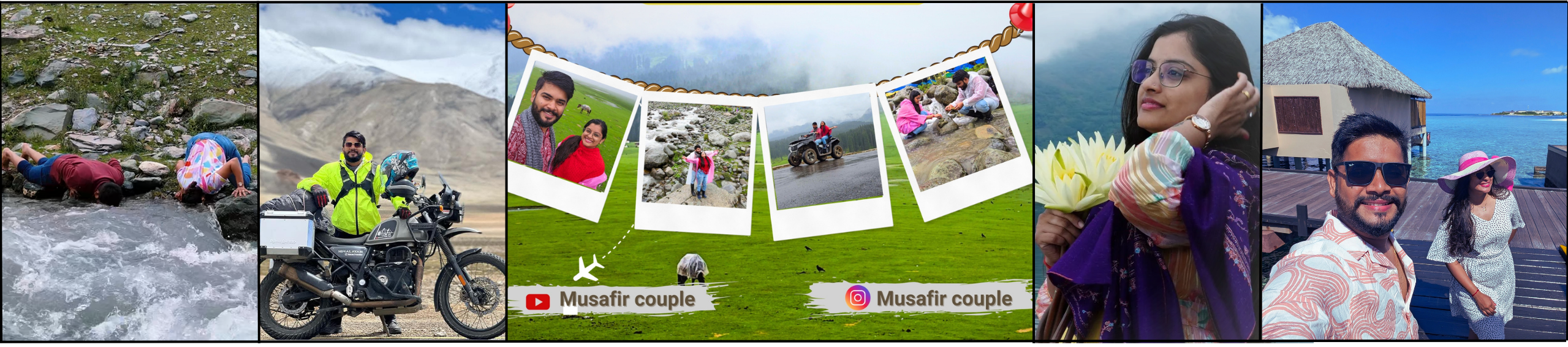
We’ve been filming our travels as Musafir Couple for years now, and here’s what we learned—viewers don’t want your highlight reel anymore. They want the real journey. The confusion. The budget calculations scribbled on a phone notepad. The “should we turn back or keep going?” moments that define every trip.
This shift changed everything for us. When we stopped trying to look like professional travel influencers and started showing actual couple travel—complete with our Hindi-Marathi-English mix, the bargaining fails, Ketan’s terrible navigation, and Samprita’s “I told you so” moments—our audience finally showed up.
So if you’re a couple wanting to document your travels, here are couple travel vlog ideas that show the real journey, not just the Instagram-ready bits. These are ideas we’ve tested, ideas that worked, and a few that bombed before they clicked.
Show the Planning Mess, Not Just the Plan
Everyone films the destination. Almost nobody films the night before.
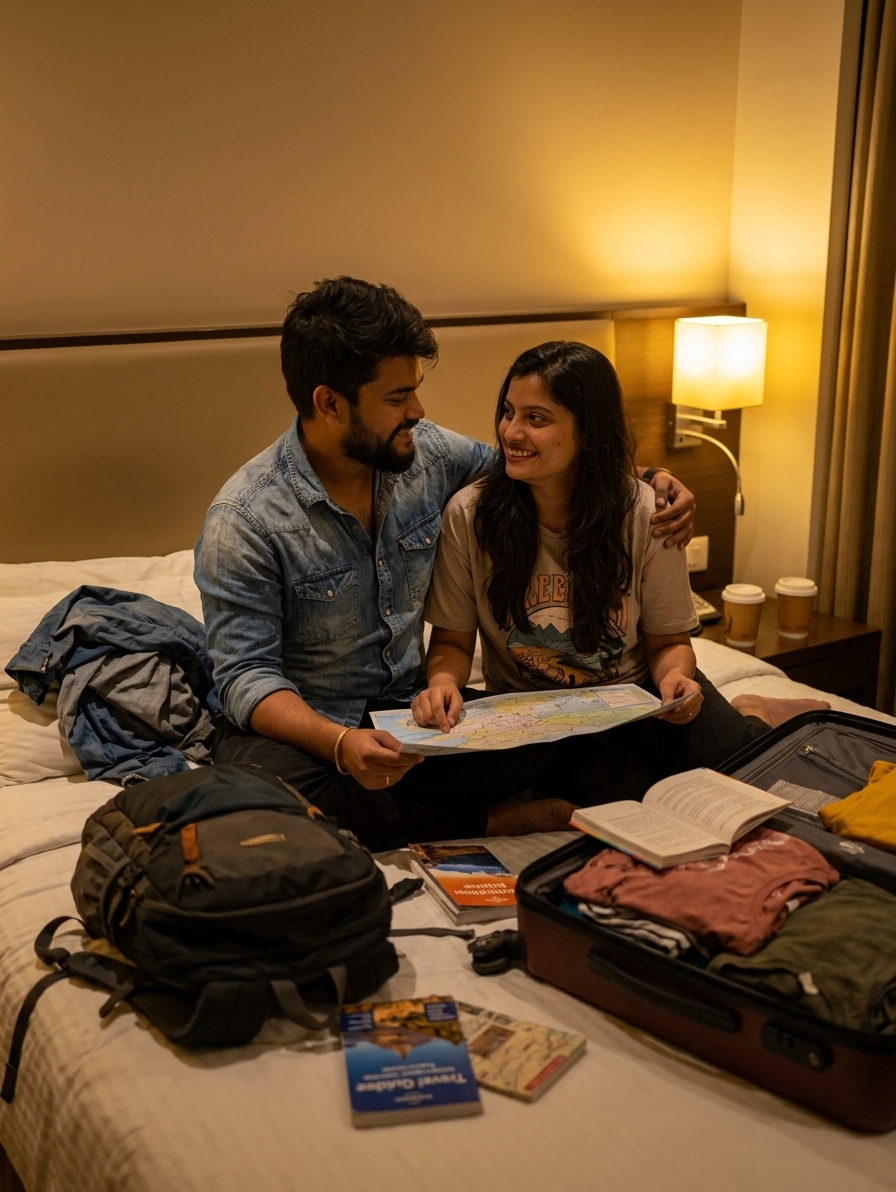
Sit down with your laptop, your phone, your notes app chaos, and film the actual planning. Show how you’re figuring out the budget. Read out the hotel reviews—good and bad. Zoom in on the Google Maps route while you debate whether to take the highway or the scenic route that adds two hours.
This is authentic travel vlogging that people search for but rarely find. We filmed one planning session where we were trying to choose between Mulshi and Pawna for a weekend getaway. Samprita wanted the cheaper option. Ketan wanted better roads. We didn’t edit that tension out—we left it in. That vlog got more saves than most of our destination videos because couples related to it. They face the exact same arguments.
Include your criteria. Show the spreadsheet if you use one. Talk through the compromise. This isn’t boring—it’s the part where viewers see themselves in you.
Film the Travel Day, Not Just the Arrival
The drive is half the trip. Maybe more.
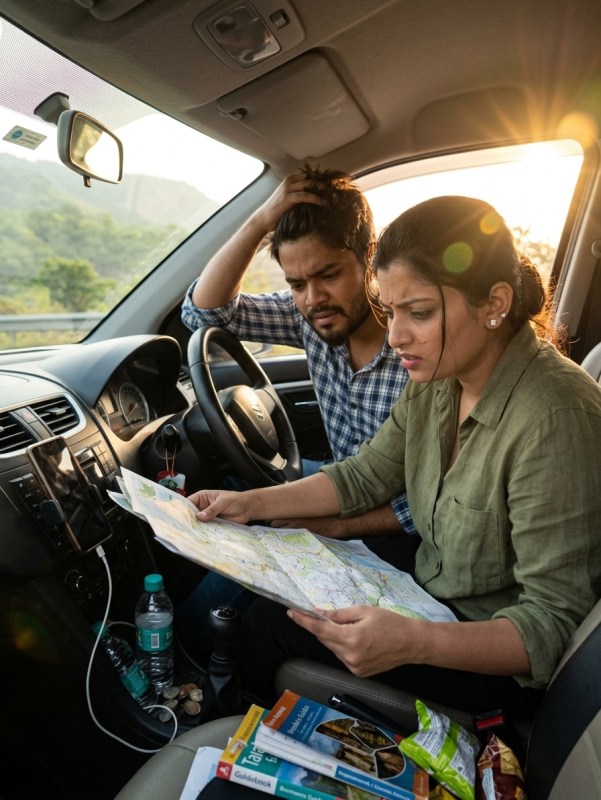
But most vlogs jump straight from home to destination with a three-second transition. You’re throwing away the best content. The road itself—the toll booths, the bad stretches, the tea stops, the “are we going the right way?” panic—that’s where real journey travel content lives.
We started dedicating entire vlog segments to the travel day. Not sped-up montages. Actual clips. Ketan talking through fuel costs at each pump. Samprita pointing out the road conditions—because if it’s a dirt track for five kilometers, people need to know that before they take a low-clearance car. The random conversations that happen when you’re stuck in traffic near Lonavala on a long weekend.
One of our highest-engagement vlogs was almost entirely the drive to Bedse Caves. We showed the wrong turn we took. The village road that wasn’t on Maps. The local guy who redirected us. People commented that they felt like they were in the car with us. That’s the bar now—not cinematic, but close.
Record the First Reaction, Uncut
You arrive. You see the place for the first time. That reaction? Don’t reshoot it.
This is one of those travel vlog challenges most creators fail—they stage the arrival. They get to the hotel, scope it out, then go back to the car and film a fake “wow, look at this place” reaction. Viewers can tell. Always.
We keep one camera running from the moment we pull up. Sometimes it’s shaky. Sometimes Samprita’s mid-sentence when Ketan starts filming. Sometimes the first thing we say is “this looked bigger in the photos.” That honesty is what separates real content from influencer content.
When we reached a farmstay near Mulshi that we’d booked based on photos alone, our first reaction was confusion—the lakeview they’d advertised was technically true, but you had to walk through a construction site to see it. We kept that in the vlog. And we got messages thanking us for showing what the listing didn’t. That’s your job as a couple documenting real travel—show what happens before you adjust your expectations.
Talk Money, On Camera, With Specifics
Most travel vlogs treat money like a secret. We treat it like the most useful piece of information we can give.
After every expense—toll, parking, entry fee, meal, stay—one of us says the amount out loud, on camera. Not in a voiceover added later. Right there, in the moment. It sounds small, but this is the single most-requested thing in our comments. People want to know what the trip actually costs, not a vague “budget-friendly” claim in the description.
Here’s a behind the scenes travel stories moment we cut once and regretted—we’d bargained a room rate down from ₹3500 to ₹2800 at a homestay in Mahabaleshwar. The negotiation took eight minutes. We thought it was boring and trimmed it to fifteen seconds. Big mistake. People wanted to see how we got that discount. What we said. How the owner responded. The next time we negotiated on camera, we kept the whole thing in. It’s awkward, yes. That’s exactly why it works.
Fuel, tolls, food, stays, entry tickets, parking, guide fees—every single one gets mentioned, with context. If a ₹500 meal was worth it, we say why. If a ₹200 entry fee was a waste, we’re clear about that too.
Include the “Should We?” Debate
Every trip has at least one moment where you’re standing at a decision point. Literal or metaphorical.
Should we take that muddy side road to the waterfall? Should we pay extra for the lake-facing room? Should we skip this spot and go straight to the next one? Should we eat at the resort or find a local place? Film that debate.
This is where couple dynamics show up—and it’s gold for real journey travel content. Samprita’s usually the cautious one. Ketan usually wants to “just try it.” Sometimes she’s right. Sometimes he is. Sometimes we make the wrong call and have to backtrack. All of that goes in the vlog.
We were deciding whether to drive an extra forty minutes to Salaulim Dam in Goa or head back to the hotel. It was late afternoon. We were tired. We debated it on camera, decided to go, and it turned out to be one of the most peaceful spots of the trip. That decision moment—and the relief afterward—made the payoff mean something. If we’d just shown the dam, it would’ve been another pretty location. Showing the doubt made it a story.
Show What Went Wrong
The wrong turn. The bad meal. The place that didn’t live up to the photos. The rain that ruined your plan. The fight that happened because someone forgot to pack the charger. Show it.
We used to cut all the friction. Every vlog was smooth, positive, “travel goals” stuff. Engagement was average. Then we posted a vlog where almost everything went wrong—the homestay had no hot water, the route we took added an hour, Samprita was visibly annoyed, and Ketan got defensive. We almost didn’t upload it. It became our most-watched vlog that month.
People don’t relate to perfect. They relate to real. And real travel is full of small disasters. When you show them, you’re not complaining—you’re being honest. There’s a big difference. Complaining is “this place sucks.” Honest is “here’s what didn’t work, here’s what we’d do differently, here’s whether we still think it’s worth visiting.”
One couple travel vlog idea we recommend: dedicate a short segment in every vlog to “what we’d change.” It keeps you from sounding negative while still giving practical warnings. It’s useful. That’s all content needs to be.
Capture the In-Between Moments
Not every moment needs a purpose. Some just need to be included because they happened.
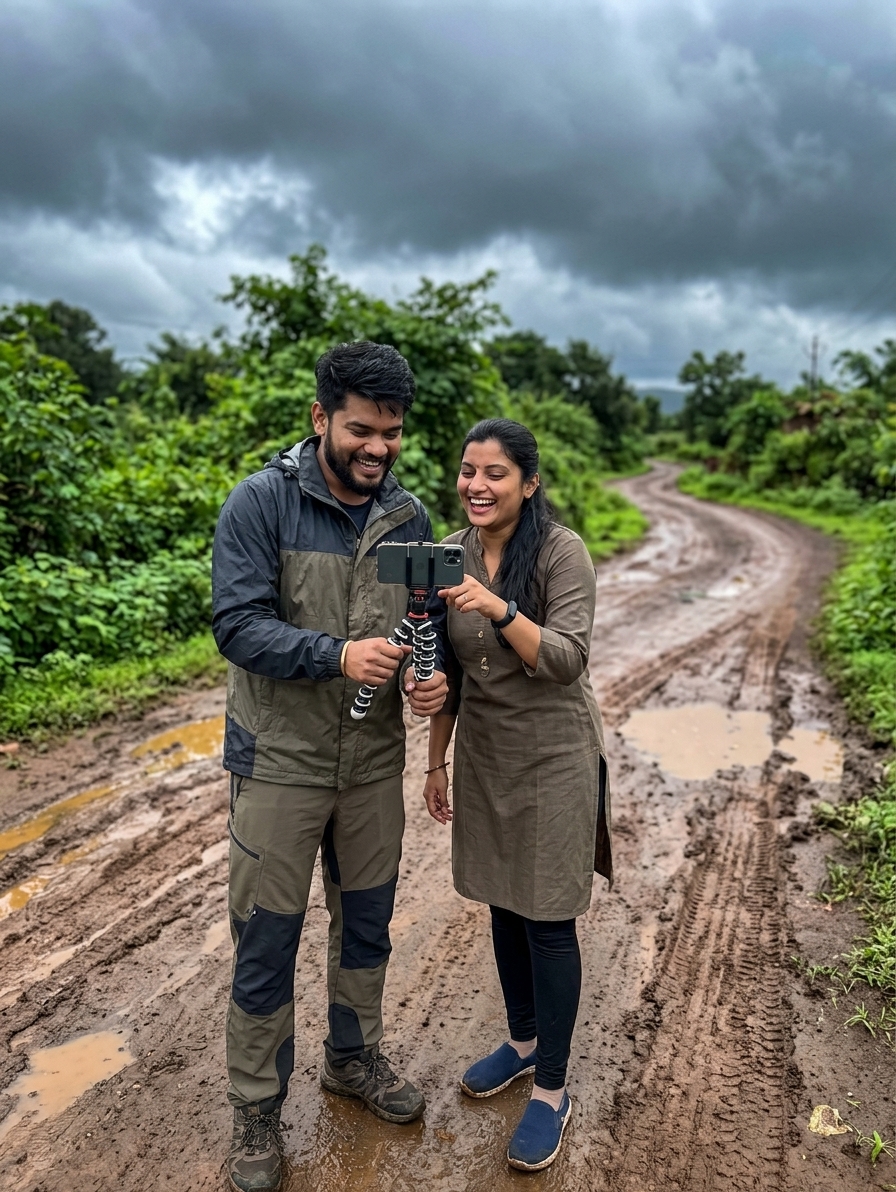
Sitting in the car waiting for rain to stop. Scrolling through your phone trying to find a restaurant. Walking back from the beach in silence because you’re both tired. Ketan trying to set up a tripod on uneven ground while Samprita laughs at him. These in-between moments are where people see the relationship, not just the travelers.
We used to cut these because they didn’t “move the story forward.” But vlogs aren’t short films. They’re documentation. And the mundane bits—especially for couple travel—are what make viewers feel like they’re actually on the trip with you. They’re not looking for a highlight reel. They’re looking for texture.
Try this: leave your camera running for two minutes while you’re doing something boring. Packing the car. Waiting for food. Walking through a market without talking. Don’t stage it. Just let it record. You’ll be surprised how much of that footage feels real in a way that your planned shots don’t.
Film the Local Interactions, With Permission
The chai stop where the owner told you about a hidden temple. The auto driver who gave you route advice. The homestay host who shared family stories. The shopkeeper who explained why everyone visits this spot during monsoon. These interactions are content.
Always ask permission first. Always. But when someone’s willing, let the camera capture the conversation. Not as b-roll. As the actual focus. This is the heart of authentic travel vlogging—the people you meet shape the journey as much as the places you see.
We met a local guide near Bedse Caves who told us stories about the carvings that we’d never find on Google. We asked if we could film him explaining it. He agreed. That ten-minute segment taught us more than any travel blog could. And viewers loved it because it wasn’t us pretending to know everything—it was us learning, on camera, from someone who actually did.
If someone says no, respect it. Don’t sneak shots. If they say yes, credit them by name if they’re comfortable with that. This isn’t extractive content—it’s collaborative storytelling.
Record the End-of-Day Debrief
You’re back at the hotel or homestay. You’ve dumped your bags. You’re sitting on the bed or the balcony, shoes off, guard down. That’s when you film the debrief.
What worked today? What didn’t? What surprised you? What would you skip if you did this trip again? Are you exhausted or energized? This is one of the simplest couple travel vlog ideas, but it’s also one of the most valuable.
We do this almost every night we’re traveling. It’s unscripted. It’s often unflattering—we look tired, Samprita’s hair is a mess, Ketan’s squinting because he took his lenses out. But it’s honest. And it gives the vlog a reflective rhythm that people appreciate. It also forces us to process the day while it’s still fresh, which makes the final vlog sharper.
Sometimes the debrief reveals tension. We don’t cut that out unless it’s truly private. A small disagreement about whether we overpaid for lunch? That stays. A deeper personal issue? That’s not for the vlog. Know the line.
Use the “Worth It or Not” Format
End every destination, activity, or experience with a clear verdict—worth it or not, and for whom.
This is the format that defines Musafir Couple’s content, and it’s one you can adapt to any couple travel vlog. People don’t just want to see where you went. They want to know if they should go. And “it depends” isn’t good enough—you need to give context.
For example: A lakeview farmhouse plot visit near Pawna. Worth it if you’re seriously considering buying property and want to see options in person. Not worth it if you’re just a casual weekend traveler—it’s not a tourist activity. That clarity helps people decide if the content applies to them.
Or: A resort in Mahabaleshwar. Worth it for couples celebrating an anniversary who want quiet and service. Not worth it for budget travelers or families with kids looking for activities. You’re not gatekeeping—you’re guiding.
This verdict framework works for everything. Food. Stays. Routes. Viewpoints. Spiritual sites. It turns every vlog into a useful resource, not just a story.
Don’t Skip the Goodbyes
You’re checking out. You’re loading the car. You’re taking one last look at the place before you drive away. Film it.
Most travel vlogs end at the highlight—the sunset, the temple visit, the perfect meal. But the trip doesn’t end there. It ends when you leave. And that goodbye moment, especially if the place meant something to you, is emotional content that people connect with.
We filmed our drive away from a homestay in Mulshi where we’d spent two quiet days. No big activity. Just walks, conversations, and rest. As we pulled out, Samprita said, “I don’t want to leave.” That one sentence captured the whole experience better than any montage could. We kept it in. People said it made them want to go.
The goodbye also sets up the “would we come back?” question, which is another version of the worth-it verdict. If you’re genuinely sad to leave, that says more than a scripted recommendation ever could.
Frequently Asked Questions
What equipment do we really need for couple travel vlogs?
You don’t need much. A smartphone with decent video quality, a small tripod, and a wireless mic if you’re filming outdoors where wind is an issue. We started with just a phone. Expensive gear doesn’t make content authentic—your willingness to show real moments does. Upgrade only when your current setup is actually limiting the story you want to tell.
How do we stay authentic without oversharing private moments?
Draw a line before you start filming. Decide together what’s on-camera and what’s off. Disagreements about the trip? Fair game. Deeper relationship conflicts? Private. Money discussions? Useful. Personal finances unrelated to the trip? Not for the vlog. The rule we follow—if it helps someone plan their trip, it’s probably worth including. If it’s just drama, leave it out.
Should we script our couple travel vlogs or keep them spontaneous?
Keep them spontaneous, but have a loose shot list. Know what information you need to cover—costs, routes, timing, access, our honest take. But don’t script the dialogue. Real conversations sound different from scripted ones, and viewers notice. We’ll sometimes do a second take if one of us totally fumbled, but we never rehearse. The stumbles and corrections make it feel lived-in.
How long should each travel vlog be to keep viewers watching?
Fifteen to twenty-five minutes works for us, depending on the destination. Longer if it’s a multi-day trip with real journey travel content. Shorter if it’s a quick day trip. Don’t pad it to hit a length. If you’ve shown everything useful and honest, end it. Viewers will stay for substance, not duration. Watch your retention graph—if people drop off at minute twelve, your content after that probably isn’t serving them.
Start Filming the Real Trip, Not the Perfect One
You don’t need better locations. You need better honesty.
That’s the shift that changed everything for us at Musafir Couple, and it’s the same shift that’ll make your couple travel vlogs worth watching. Stop curating. Start documenting. Show the planning chaos, the travel day, the money talks, the wrong turns, the goodbyes. Show the version of travel that people actually experience but rarely see online.
Couple travel vlog ideas aren’t about finding new formats—they’re about using old formats with new honesty. The planning video, the drive, the debrief, the verdict—none of these are groundbreaking. But when you do them without the polish, without the staging, without the fear of looking imperfect, they become something people actually trust.
If you’re a couple starting your travel content journey and you want guidance from people who’ve tested this approach across Maharashtra, Goa, Gujarat, Karnataka, and beyond—reach out to us at Musafir Couple, powered by Travelheal. We’ve made every mistake, learned what works, and we’re happy to share what real couple travel vlogging actually looks like. Not the guru version. The practitioner one.
Now go film your next trip. The messy, real, unfiltered version. That’s the one people are searching for.