

 by
by How to Plan a Perfect Couple Trip in India Without Losing Your Mind or Your Partner – Real Cost Breakdowns, Route Planning, Booking Hacks and Honest Tips from Musafir Couple
Planning a couple trip in India means choosing destinations together, setting realistic budgets with actual costs, booking stays that match both preferences, creating flexible itineraries, researching routes and road conditions, agreeing on food adventures vs comfort meals, and leaving room for spontaneous detours without either person feeling unheard or overwhelmed.
We’ve learned this the hard way. Our first trip as Musafir Couple was supposed to be a smooth three-day Lonavala weekend. Ketan wanted to leave at 5 AM to beat traffic. Samprita wanted to sleep in. He booked a resort with trekking. She expected a spa. By day two, we weren’t talking much. The views were stunning, but the vibe was off.
That trip taught us everything we now share with couples planning their journeys. Couple trip planning India isn’t just about picking a destination and hitting the road. It’s about honest conversations before booking anything, splitting research duties, acknowledging different travel styles, and building an itinerary that doesn’t feel like a compromise but an adventure you’re both excited about.
Most travel blogs give you itineraries. We’re giving you the framework that actually works when two people with different morning routines, budget comfort zones, and ideas of “relaxing” try to plan something together without it turning into a negotiation.
Why Most Couple Trips Fail Before They Even Start
The problem isn’t the destination. It’s the planning process.
One person does all the research. The other just says “whatever you want is fine” until they’re at the location and suddenly they’re not fine with anything. Or both people assume the other is handling bookings. Or someone books everything as a surprise, and the surprise is that their partner hates early morning activities.
Here’s what we see constantly: couples pick a place based on Instagram photos, book the first decent-looking hotel, pack the night before, and assume the trip will magically work itself out. Then reality hits. The hotel is 14 kilometers from the actual attraction. The food options near the stay are terrible. One person wants to wake up and explore, the other wants to sleep till noon. The budget conversation never happened, so every meal becomes an awkward “is this too expensive?” dance.
Romantic trip planning sounds soft and dreamy. Real romantic trip planning is sitting together with a notes app, splitting the research, being honest about money, and designing something that doesn’t exhaust one person while boring the other.
When we started documenting couple travel through Musafir Couple, we realized our messy, unfiltered planning sessions were more valuable than our polished vlogs. Couples kept asking — how do you two actually agree on anything? How do you split costs? Who picks the hotel? Do you ever just want to do different things?
Yes. All the time. That’s normal. The trick is planning for that reality instead of pretending it won’t happen.

The Pre-Trip Conversation That Saves Every Argument Later
Sit down. Open your calendar. Have the actual conversation.
Not “where should we go?” Start earlier. What does each of you need from this trip? Samprita needs at least one morning where she doesn’t have to wake up before 8 AM. Ketan needs to try at least two local food spots that aren’t on Google’s top ten. I need some quiet time with a book. He needs some time to shoot content without me saying “are you done yet?”
Write it down. Your list won’t match. That’s fine.
Now talk about money — the real budget, not the “we’ll figure it out” budget. What’s the total you’re both comfortable spending? Include everything: fuel, tolls, food, stays, entry fees, that random coconut water stop, parking charges. Add 18% buffer for stuff you didn’t think about. We learned this after our Mahabaleshwar trip where we budgeted ₹8,000 and spent ₹11,200 because we didn’t account for parking at every single viewpoint.
Next: travel style. One of you might love waking up at sunrise to catch empty roads. The other might consider anything before 9 AM a crime against humanity. One might want itinerary discipline. The other wants zero plans. Neither is wrong. Both need acknowledgment.
Decide right now: are you doing a packed trip or a slow trip? Packed means multiple spots, early starts, tight schedules. Slow means picking one base location, taking your time, maybe staying in bed till noon one day because you’re on vacation and that’s allowed.
At Musafir Couple, we’ve shifted toward slower trips. We used to cram four destinations into three days and come back exhausted. Now we pick one place, one great stay, and explore radius spots without the pressure. Our Mulshi content performs better because we weren’t rushing. We actually experienced the place instead of just ticking boxes.
Last part of this conversation: decision-making. Who’s booking stays? Who’s researching routes? Who’s handling food research? Split it. Don’t let one person become the trip manager while the other just shows up.
Picking the Right Destination for Both of You (Not Just Instagram)
Stop picking places because they trend. Pick places that match your combined energy.
If one of you loves adventure and the other loves lounging, don’t pick a destination that’s only one thing. Pawna works because you can camp by the lake and also do absolutely nothing. Goa works because you can party in North Goa and disappear into quiet villages in South Goa. Coorg works because there are treks and there are coffee estate stays where you read books all day.
Bad fit: booking a hardcore trekking spot when one person doesn’t want to hike. Bad fit: booking a beach resort when one person gets bored sitting still. Bad fit: picking a spiritual destination when one person isn’t into temples and the other wants darshan at every stop.
We’ve done this wrong. Our Kashmir trip was beautiful but stressful because Ketan wanted to cover Gulmarg, Pahalgam, and Sonamarg in five days. Samprita wanted to stay by Dal Lake and soak it in. We tried to do both and did neither properly. That taught us — if you can’t agree on the vibe, pick a different destination entirely.
Couple vacation ideas should start with: what kind of trip do we both want right now? Rest? Adventure? Culture? Food? Spirituality? Romance without interference? Then filter destinations through that lens.
For couples around Pune, we’ve tested enough spots to say this clearly:
- Mulshi, Lonavala, Kamshet — if you want close, easy, flexible weekend escapes
- Mahabaleshwar, Panchgani — if you want cool weather, walks, and strawberry everything
- Goa (South) — if you want beaches without crowds, seafood, and village vibes
- Karnataka (Coorg, Chikmagalur) — if you want hills, coffee, and slow mornings
- Gujarat (Dwarka, Somnath, Diu) — if you want spirituality mixed with coastal beauty
- Rajasthan — if you want palaces, culture, and completely different energy
Choose based on drive time, budget, season, and honestly — how much coordination it’ll take. Some trips need more planning. Some you can wing.

Building a Flexible Itinerary That Doesn’t Feel Like a Schedule
Itineraries should guide, not dictate.
Start with anchor activities — the two or three things you both actually want to do. Everything else is optional. If you’re going to Mahabaleshwar, maybe your anchors are: stay at a lakeview property, visit Venna Lake, try one strawberry farm. That’s it. Everything else — viewpoints, markets, random drives — happens if you feel like it.
Block time, don’t pack time. Instead of “9 AM breakfast, 10 AM checkout, 11 AM viewpoint one, 12:30 PM viewpoint two,” try “morning: explore nearby, afternoon: chill at stay, evening: sunset drive.” Give yourself windows, not deadlines.
We used to plan every hour. It made trips feel like work. Now we plan in half-days. Morning chunk, afternoon chunk, evening chunk. One activity per chunk maximum. The rest is buffer time for naps, spontaneous detours, longer meals, getting lost, or just sitting somewhere because it feels good.
Here’s a real example from our recent Alibaug trip:
Day 1 — Afternoon: Reach and check-in. Evening: Walk to Alibaug beach, street food.
Day 2 — Morning: Sleep in or early beach walk (individual choice). Afternoon: Kolaba Fort visit. Evening: Resort time, dinner at local spot we found on the way.
Day 3 — Morning: Slow breakfast, pack. Afternoon: Drive back via Kashid beach stop if we feel like it.
That’s it. Three days, four activities, tons of gaps. It was one of our best trips because nothing felt forced.
Couples travel tips from real experience: plan one less thing than you think you should. If you’re tempted to add a fifth stop, cut it. Tired couples fight. Rested couples enjoy the trip.
And here’s the thing nobody tells you — it’s okay to split up for an hour. If Ketan wants to shoot drone footage at sunrise and Samprita wants to sleep, he goes alone. If she wants to try a local spa and he wants to walk around the village, we separate for two hours and meet for lunch. You’re a couple, not conjoined twins. Individual freedom makes the shared time better.
Real Budget Breakdown for Couple Trips (With Actual Numbers)
Let’s talk money without the Instagram gloss.
A couple trip planning India budget depends on distance, duration, stay type, and how much you eat out. But here’s a realistic breakdown for a weekend trip (2 nights, 3 days) within 300 kilometers from Pune:
Transport (own vehicle):
Fuel: ₹2,400 (assuming 600 km total at ₹20/km average for a sedan)
Tolls: ₹450 (varies by route)
Parking: ₹200
Total transport: ₹3,050
Accommodation (2 nights):
Budget homestay: ₹3,000 (₹1,500/night)
Mid-range resort: ₹6,000 (₹3,000/night)
Lakeview villa or premium stay: ₹10,000+ (₹5,000/night)
Food (6 meals for 2 people):
Local dhabas and budget meals: ₹2,000
Mix of local and decent restaurants: ₹3,500
Resort dining and nicer spots: ₹5,000+
Activities and entries:
Viewpoint entries, boat rides, small activities: ₹800 to ₹1,500
Miscellaneous:
Chai stops, snacks, coconut water, random buys: ₹600
Total realistic budget:
₹9,450 (bare budget)
₹13,950 (comfortable mid-range)
₹19,000+ (premium experience)
We’ve done trips for ₹8,000 and trips for ₹25,000. Both were good. The difference wasn’t enjoyment, it was comfort level and stay quality. The ₹25,000 trip had a private pool and better food. The ₹8,000 trip had a cute homestay, homecooked meals, and honest conversations with the host family about local life.
Neither is better. Know what you’re optimizing for.
How to plan honeymoon on a budget? Same framework. Stretch it to five days instead of three. Pick off-season rates. Book midweek instead of weekends. Choose destinations that aren’t peak honeymoon hubs (skip Maldives if you’re budget-tight; try Gokarna or Goa South instead). A Goa honeymoon in July will cost you half of what it costs in December, and the rains make it stunning if you’re okay with getting wet.
Also — split costs transparently. We transfer 50-50 after every trip. Some couples pool into one account before the trip. Some alternate — one pays stays, other pays food. Find your system, but don’t leave it vague. Money fights kill romance faster than bad hotel rooms.
How to Pick Stays That Won’t Ruin Your Trip
The stay matters more than the destination. We’ll say it again — a great property in an average location beats an average property in a great location.
Start with location within the location. Don’t just search “hotels in Lonavala.” Lonavala is big. Do you want to be near the lake, in the hills, close to the market, or isolated in the forest? Decide first, then filter.
Check these things before booking:
Real photos, not promotional ones: Scroll reviews for guest-uploaded images. Marketing photos lie. Guest photos show the breakfast spread, the actual room size, the view from the balcony.
Accessibility: Is it easy to reach or do you need a 4×4 for the last three kilometers? We’ve booked “secluded” stays that required off-roading our sedan couldn’t handle. Now we ask: what’s the road condition?
Couple-friendly confirmation: Sounds obvious, but some homestays and smaller properties still have weird policies. If the listing doesn’t clearly say couple-friendly or the reviews mention ID checks and interrogation, skip it.
Cancellation policy: Free cancellation until 24-48 hours before is non-negotiable for us now. Plans change. Someone gets sick. Work emergges. Losing ₹5,000 because you can’t cancel sucks.
What’s included: Breakfast? Wi-Fi? Hot water? Parking? Don’t assume. We’ve reached places where “breakfast” meant two slices of bread and jam.
We’ve stayed in ₹1,200/night homestays that felt like home and ₹6,000/night resorts that felt soulless. Price isn’t the signal. Hospitality, honesty, and whether the host actually cares — that’s the signal.
For our Mulshi and Pawna content on Musafir Couple, we’ve reviewed over thirty properties. The ones we recommend aren’t always the fanciest. They’re the ones where the host responds within an hour, gives you honest directions, tells you about the pothole on the way, and checks if you need anything without being intrusive.
Read between the review lines. If multiple people mention “host was very strict about checkout time,” that’s a vibe indicator. If people say “felt like visiting family,” that’s different energy.
And here’s a contrarian take: sometimes the property with 4.2 stars and 80 reviews is better than the one with 4.8 stars and 12 reviews. More data, more honesty. Early reviews are often friends and family.
The Art of Traveling Together Without Driving Each Other Crazy
You will annoy each other. That’s not a bug, it’s a feature of spending 72 hours straight together outside your normal environment.
Ketan hates when Samprita takes 40 minutes to get ready and then says “just five more minutes.” Samprita hates when Ketan gets fixated on finding the “perfect” photo angle and makes us late for sunset. We’ve learned to work with this, not against it.
Build in solo time. Even just an hour. One person walks around the property. The other reads. One naps. The other explores the nearby village. You don’t have to be together every second. Some of our best trip memories are the stories we told each other after doing separate things for a bit.
Accept different rhythms. Morning people and night people don’t magically sync on vacation. Let the morning person wake up, have chai, watch sunrise. Let the night person sleep. You’ll meet at breakfast and both be happier.
Disagree without drama. If you reach a viewpoint and one person thinks it’s beautiful and the other thinks it’s overhyped and crowded, both opinions can exist. You don’t need consensus on everything. Samprita loved Bedse Caves. Ketan thought it was fine but not worth the climb in that heat. We documented both perspectives. That’s real couple travel.
Romantic trip planning doesn’t mean agreeing on everything. It means creating space for two different people to enjoy the same trip in slightly different ways without one person’s experience invalidating the other’s.
Trade-offs work. Ketan gets his sunrise drive. Samprita gets to sleep in the next morning. She picks lunch spot. He picks dinner spot. You visit his temple. You skip her shopping detour. Not every trade needs to be announced or negotiated. Just stay aware of the balance.
And please — put the phone down sometimes. We create content, so we’re guilty of over-documenting. But our best moments aren’t on camera. They’re in the car, driving back, talking about something random, windows down, no agenda. If you’re filming everything, you’re not experiencing anything.
What to Do When Things Go Wrong (Because They Will)
Your car will overheat. Your booking will get messed up. It’ll rain when the forecast said clear skies. The “highly rated” restaurant will be closed. You’ll fight about something stupid. That’s travel.
We’ve had a flat tire on the way to Mahabaleshwar. We’ve reached a resort that looked nothing like the photos. We’ve driven two hours to a beach that was covered in trash. We’ve fought about whether to turn back or push forward. We’ve gotten food poisoning. We’ve missed sunsets because we got lost.
None of those trips were ruined. Some became our best stories.
Here’s the framework: when something goes wrong, give it fifteen minutes before deciding how big a problem it actually is. Immediate reactions are usually disproportionate. Sit down. Drink water. Talk about options. Then decide.
If the stay is terrible, check if you can get a refund and move. If you can’t, make it an adventure. We’ve turned a disappointing resort stay into a “let’s explore everything nearby instead of staying in” day. It became our most spontaneous, unplanned, fun day of that trip.
If you’re fighting, pause the agenda. Don’t try to push through attractions while annoyed with each other. Stop somewhere. Get chai or cold coffee. Talk or don’t talk, but don’t keep driving angry. We’ve pulled over at random dhabas, sat for an hour, reset, and continued. Sometimes the break matters more than the itinerary.
If weather kills your plans, have a backup that’s indoors or weather-proof. Museums, local cafes, spas, or just resort time. Rain isn’t a disaster if you planned for the possibility.
And here’s the thing about couple travel — sometimes the trip that goes slightly wrong bonds you more than the perfect trip. You’ll laugh about the wrong turn, the terrible hotel, the meal that was so bad you left after two bites. Those become your stories. Perfect trips are boring to remember.
Post-Trip Reality Check: Was It Actually Worth It?
This is the question we ask after every trip on Musafir Couple, and it’s the most honest filter for whether you’d recommend a place to another couple.
Sit together after you’re back. Not immediately — give it two days. Then talk:
- Would you go back?
- Would you recommend it to friends?
- What would you do differently?
- What surprised you (good and bad)?
- Was the cost worth the experience?
We rate trips on three things: memories made, stress level, and whether we’d repeat it. High memories, low stress, yes repeat — that’s a winner. High memories, high stress — good once, wouldn’t do again. Low memories, any stress — not worth it.
For us, Mulshi has high repeat value. Low effort, close drive, always beautiful, plenty of new spots to discover each time. Maldives was unforgettable but high cost and high effort — not something we’d do every year. Lonavala during monsoon weekend — beautiful but stressful because of traffic and crowds. We’ve learned to go midweek instead.
Track what worked:
- Did the flexible itinerary actually feel better than packed schedules?
- Did splitting research make planning easier?
- Did the budget hold or did you overspend (and why)?
- Did you both get what you needed from the trip?
Improve for next time. If you fought about morning wake-up time, plan different mornings next trip. If you felt rushed, cut one activity from the next itinerary. If you loved the slow pace, do even less next time.
Some couples keep a travel journal or notes app. We keep a shared Google Doc with trip reflections: costs, places, what worked, what didn’t, random memories. It helps when planning the next one. We’re not repeating mistakes, and we’re repeating what made us happy.
Frequently Asked Questions
How much does a couple trip in India cost for 3 days?
A realistic 3-day couple trip within 300-400 km costs between ₹9,500 to ₹20,000 depending on stay type, transport mode, and food preferences. Budget trips with homestays and local food can work under ₹10,000. Mid-range trips with decent resorts and restaurant meals typically land around ₹14,000 to ₹16,000. Premium stays with pools, resort dining, and activities push it above ₹20,000. Always add an 18% buffer for unplanned expenses like parking, tolls, and random stops.
What is the best month for couple travel in India?
October to March works best for most destinations in India — comfortable weather, clear skies, manageable heat. April and May are brutal in plains but great for hill stations. June to September brings monsoons which are stunning for Western Ghats destinations like Lonavala, Mulshi, Mahabaleshwar but tricky for road trips if you’re not comfortable driving in rain. Avoid peak holiday weeks like Diwali, Christmas, and New Year unless you book two months ahead and don’t mind crowds and inflated prices.
How do we plan a honeymoon on a tight budget?
Pick off-season travel dates to save 35-40% on stays and flights. Choose destinations closer to your city to cut transport costs. Book midweek instead of weekends for better rates. Look at homestays and boutique properties instead of big resorts — often better hospitality at half the price. Cook one meal a day if your stay has a kitchenette. Focus on experiences over luxury — a beautiful sunset costs nothing. Goa in monsoon, Coorg in summer, Rajasthan in July — off-season doesn’t mean off-experience.
Should we book everything in advance or leave room for spontaneity?
Book your stay in advance, especially for weekends and peak seasons. Book transport if you’re flying or taking trains. Everything else — activities, restaurant reservations, exact timing — leave flexible. We’ve learned that over-booking kills spontaneity and under-booking creates stress. The sweet spot: confirm where you’re sleeping and how you’re getting there, leave the rest open. This protects you from sold-out properties while keeping the trip flexible enough to follow interesting detours or skip things that don’t excite you anymore.
How do couples handle different travel styles without fighting?
Acknowledge differences before the trip, not during. If one person loves early starts and the other doesn’t, plan some solo mornings. If one loves planning and the other prefers winging it, split the itinerary — plan anchor activities, leave gaps unplanned. Trade-offs work better than compromise — you pick lunch, I pick dinner. Build in alone time even if it’s just an hour. Accept that you don’t need to love every moment equally — Samprita can love a temple visit while Ketan finds it okay, both experiences are valid. The goal isn’t synchronized enjoyment, it’s mutual respect for different preferences.
Ready to Plan Your Next Couple Escape? Let’s Make It Real
Couple trip planning India doesn’t need to be complicated, stressful, or a test of your relationship. It needs honesty, a bit of structure, and a lot of flexibility.
Start with the conversation. Talk about what you both actually want, not what Instagram says you should want. Set a real budget with buffer. Pick a destination that works for both travel styles. Build a loose itinerary with breathing room. Book a stay you’ve researched properly. Leave space for things to go slightly wrong and for spontaneous detours that become the best parts.
At Musafir Couple, we’ve planned dozens of trips — some were beautifully smooth, others were chaotic messes that somehow turned into great memories. The difference was never the destination. It was whether we were traveling together or just happening to be in the same car.
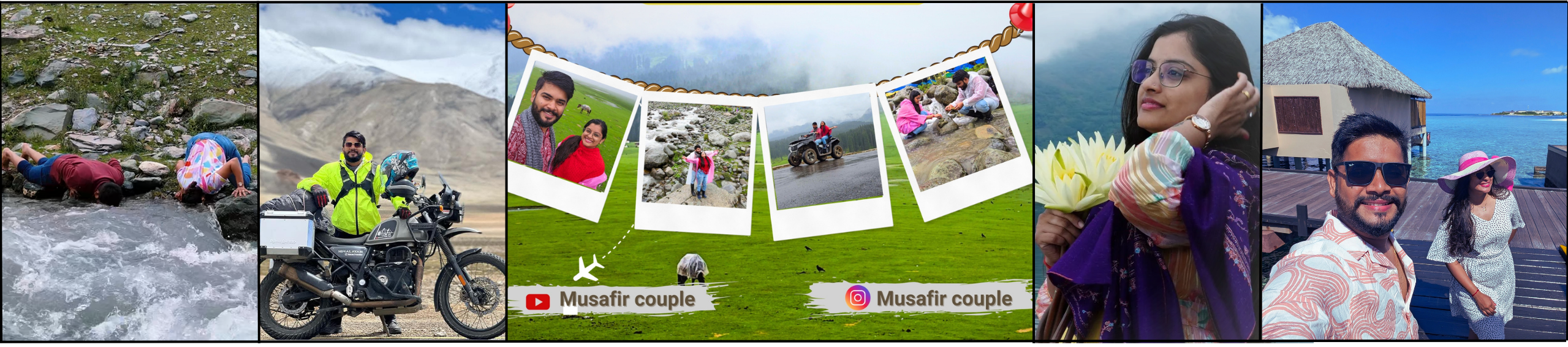
If you want real, unfiltered couple travel stories with actual costs, honest reviews, and the kind of details that help you plan better — follow Musafir Couple on our journey. We’re documenting everything from weekend getaways around Pune to longer road trips across India, always showing the reality behind the destination: the good roads and the bad ones, the worth-it stays and the overhyped ones, the moments we loved and the mistakes we made.
Your next couple trip shouldn’t feel like a compromise. It should feel like an adventure you’re both genuinely excited about. Plan it that way, and the destination almost doesn’t matter — you’ll enjoy the journey either way.
Start planning. Talk tonight. Pick a weekend. Make it happen.