

 by
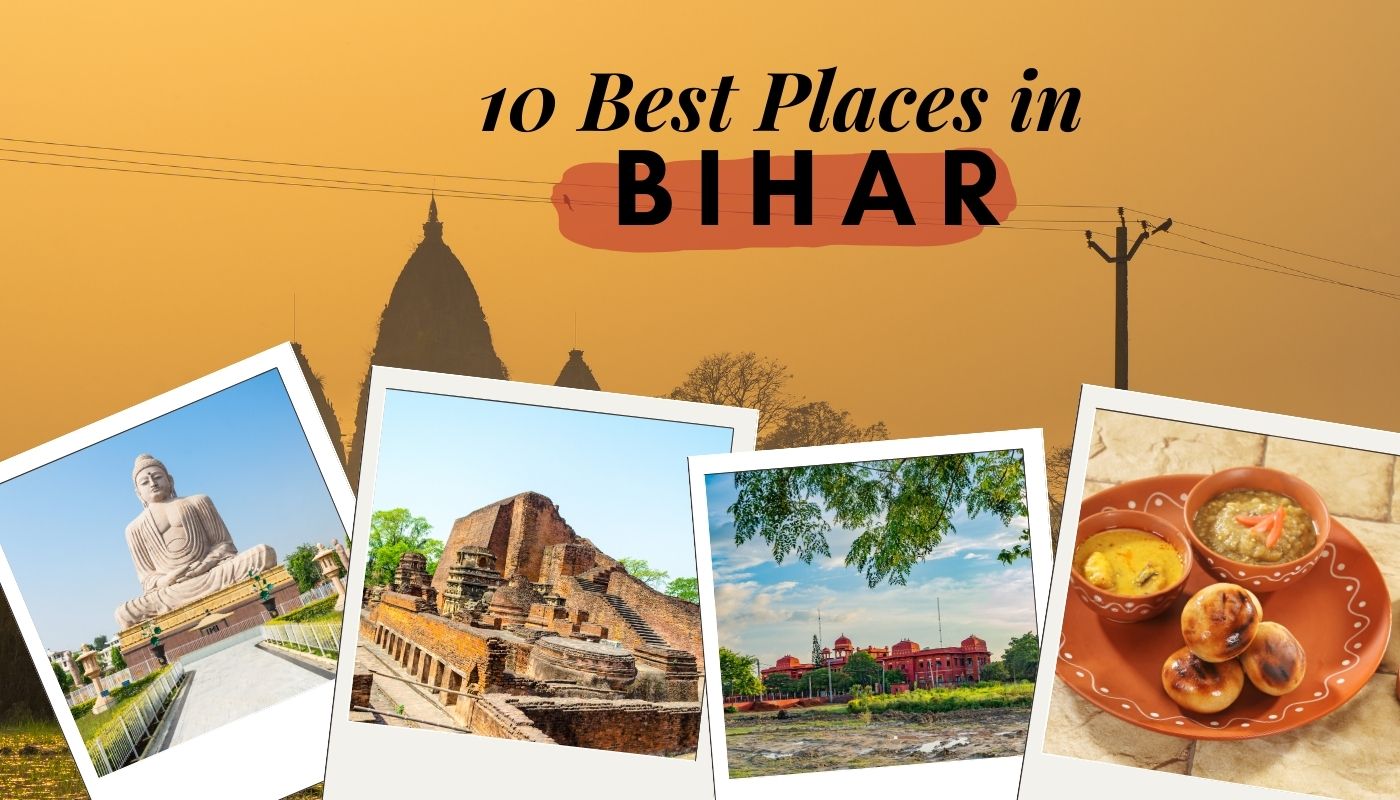
Bihar is a state of history and culture located in the fertile Indo-Gangetic plains of the Indian subcontinent. Being the home to Buddhism and Jainism, Bihar is filled with places that give tourists a peek into the region’s history. Right from universities of ancient periods that were set up to attract students from across the length and breadth of the world to stupas that were built to mark certain important events, Bihar has it all in itself. Here are the top 10 places in Bihar that unveil its rich tapestry of culture and history.
Here are the top 10 places in Bihar that unveil its rich tapestry of culture and history:
1. Mahabodhi Temple, Bodh Gaya
The Mahabodhi Temple at Bodh Gaya is one of the foremost sacred places for Buddhists which is believed to be the place where the Lord Buddha got enlightenment under the Bodhi Tree. Its architectural style is said to have been influenced by the Gupta and Pala dynasties, the temple also contains a statue of a meditating Buddha that is 6 meters tall. Walking around the temple, one can distinguish the Vajrayana, an imitative diamond seat where Buddha has decided to meditate to receive the answers he was looking for. Visit the Bodhi tree, which is one of the direct descendants of the tree that Buddha used to sit under when he attained the highest knowledge.
2. Nalanda University Ruins, Nalanda
The archeological site shows you the prospect of the once glorious Nalanda University which was a center of learning in ancient India and attracting students and scholars from countries in Asia. Explore red brick structures still standing including monasteries, temples, and classrooms, and picture 2000 teachers and 10000 students living and learning here when Nalanda was at the epicenter of Indian education in the 5th-12th centuries CE. It was reported to have accommodated one of the largest libraries of the ancient world, containing numerous manuscripts from different fields.
3. Vikramshila University Ruins, Bhagalpur
The other important university during the Pala Dynasty rule was Vikramshila University which was as important as Nalanda University. Vikramshila Ruins are located on a hillock on the outskirts of Bhagalpur, Bihar where remains of stupas, temples, monasteries, and other structures provide an idea about the university. It is believed to have practiced tantric Vajrayana Buddhism and had scholars in the field of Buddhism coming from different parts of the world. Visiting the ruins, one can understand and realize the importance of this historical education facility that has been forgotten in the annals of history.
4. Patna Museum, Patna
Before proceeding to discover the cultural heritage of Bihar, it is recommended to visit the Patna Museum which exhibits a great number of relics connected with Buddhism and Jainism and the Hindu sculptures belonging to the Mauryan and Gupta periods. Look at the exquisite sculptures in stone and bronze, at such thangkas, which can be considered as proofs of the ancient history of Bihar and its significant contribution to the development of such religions as Buddhism. This museum does not have famous works of art such as the Didarganj Yakshi and a casket that is said to hold the ashes of Lord Buddha.
5. Takht Sri Patna Sahib, Patna
Takht Sri Patna Sahib is one of the most sacred shrines of the Sikh religion which was established by Guru Gobind Singh, the tenth Guru who was born at this place in 1666 CE. The manji sahib and gurdwara are located at the place of his birth while the magnificent Harmandir Sahib has been built in his memory. Bright and tangible paintings and artworks illustrate significant moments in the Guru’s life. It will be quite an experience to take a holy dip in the tanks and also take a tour around the museum that depicts the life of Guru Gobind Singh.
6. Kesaria Stupa, East Champaran
Measuring 104 feet in height, Kesaria Stupa is one of the largest Buddhist stupas in the world built entirely of bricks. Existing between 200 and 750 CE, Kesaria Stupa stands as a strong proof of Bihar as a region of Buddhism. Marvel at the engineering precision of the stupa, which was built with small bricks applied one at a time to form the dome. Local belief also has it that it is the place where the Buddha gave out food to hungry ghosts. Located in a calm and quiet area, this astonishing structure should certainly be listed on your list of places to visit in Bihar.
7. Vaishali
The sleepy village of Vaishali is recorded as the capital of the lively Licchavi republic in 599-489 BCE. Littered with Jain temples and Buddhist monuments, the place holds significant importance in these religions of India. Visit the places connected with Lord Mahavira and Lord Buddha such as Kutagarasala Vihara and Abhishek Pushkarini. This city has two lion pillars which date back to the Ashoka period and are evidence of its historical importance. Others are three crumbling Hindu shrines and the Relic Stupa which is believed to contain the ashes of Buddha.
8. Sanjay Gandhi Jaivik Udyan, Patna
Being the most famous Wildlife Park in Bihar, the Sanjay Gandhi Jaivik Udyan is also referred to as Patna Zoo which is also an ideal place for children and elderly people. The zoo which is among the biggest in India has 989 animals belonging to 136 species that grab your interest through novelty. Paved paths for walking meander through various areas – feeder, meat-eating, and flightless bird zones for fabulous sightings. Most notable is the anthropomorphic museum with information on the animals and the toy rain in the children’s park.
9. Barabar Caves
The interesting Barabar Caves are amongst the oldest surviving rock-cut caves that were constructed in the 3rd century BCE. Cut out of the rocky hills of Barabar near Gaya, these caves were constructed by Emperor Ashoka and were used by Buddhist monks for meditation purposes. The caves are situated in the area of pine trees and, interestingly, any noise will echo perfectly through the space of the caves. Gaze a cave one among them is Sudama, the particularity of which is in the fact that one of the inner walls has been polished to mirror’s sheen.
10. Sonepur Cattle Fair
While the above places give the feel of Bihar’s history and religious importance, the Sonepur cattle fair which takes place over a month gives a feel of Bihar’s rustic side. The biggest cattle fair in Asia is located at the Gandak River and has been in existence since the prehistoric period and comprises people from all the communities. One of the attractions is the Haathi Bazaar, in which the sale and purchase of beautifully adorned elephants takes place. There are rural sports, circus, folk music and dance, and shops with fascinating rural Indian artifacts giving the tourists a colorful atmosphere of rural India.
This gives you a broader view of Bihar’s past and present, people, and their roles in different centuries, as you enjoy exploring these sites. Bihar has a rich historical past, and anyone visiting this state is pampered with several sites and experiences that tell about various aspects of the state’s history – be it awestruck by university ruins, meditating at Buddhist shrines, or feeling the rustic flavor of the state during the annual Sonepur cattle fair.
Also Read: Looking into the Diverse Culture of Arunachal Pradesh


One thought on “Top 10 Places in Bihar That Unveil Its Rich Tapestry of Culture and History”