

 by
by Walking around Mount Kailash at 5,630 meters altitude changes you. Not in the Instagram-caption way—in the sit-down-and-rethink-your-life way. Ketan and I completed our Kailash Mansarovar journey in 2024, and nothing prepares you for what actually happens up there. The thin air, the physical exhaustion, the spiritual weight of it all—it’s real, it’s hard, and it’s worth every rupee and every painful breath.
This isn’t a poetic write-up about finding yourself. This is what the Kailash Mansarovar journey guide you’re reading right now actually delivers: real costs, actual routes, the permits that matter, what broke down, what worked, and whether you should even attempt it. We’ve documented everything from our base in Pune to standing at Dolma La Pass at 5,630 meters, bargaining with Tibetan shopkeepers, dealing with altitude sickness at 2 AM, and spending money we didn’t plan to spend.
You’ll find the truth here—the kind your travel agent won’t tell you because it doesn’t sound glamorous. Samprita threw up twice on the trek. I questioned the decision at least four times. Our budget went 30% over estimate. And we’d do it again tomorrow.
Why Kailash Mansarovar Deserves Your Time and Money
Most pilgrimage circuits in India take a day, maybe a week. Kailash Mansarovar yatra experience spans 18 to 21 days depending on your route, costs anywhere between ₹1.8 lakh to ₹3.5 lakh per person, and tests you physically in ways Girnar or even the Char Dham circuit never will. So why go?
Because it’s not just another temple visit. The three-day parikrama (circumambulation) around Mount Kailash sits at altitudes where your body fights for oxygen with every step. You’re walking in Tibet, crossing into a landscape that looks like another planet—barren, raw, untouched by the commercial garbage that’s taken over most Indian pilgrimage spots.
Here’s what nobody mentions: Kailash filters out casual tourists by default. The permit process, the cost, the physical demand—it all works as a natural barrier. What you get is a crowd that’s there for the right reasons. Sambhaji from Satara who saved for three years to make this trip. Priya and Ramesh from Ahmedabad who postponed it twice due to health issues. People who’ve thought about this, not influencers chasing content.
We met a 68-year-old woman from Nashik who completed the parikrama faster than us. That’s the kind of place Kailash is—it doesn’t care about your gym routine or your trekking resume. It cares about your will to keep walking when everything in you wants to stop.
The sacred lake Mansarovar sits calm and impossibly blue at 4,590 meters. Tibetan Buddhism, Hinduism, Jainism, and Bon—all four faiths hold this place sacred. That tells you something about the energy here. You feel it the moment you see the mountain. Not exaggerating—Samprita teared up, and she’s not the emotional type.
Routes to Kailash Mansarovar: Which One Actually Works
There are three main routes for the Kailash Mansarovar trek, and choosing wrong can ruin your experience or blow your budget.
Kathmandu Route (Nepal Border)
This is what most Indian pilgrims take, and it’s what we took. You fly to Kathmandu, road journey to the Tibet border, then overland through Tibet to Kailash. Takes 17 to 19 days total. Cost ranges ₹1.8 lakh to ₹2.8 lakh depending on your tour operator and group size.
Why it works: The gradual altitude gain gives your body time to acclimatize. You spend two days in Kathmandu, then slow travel through places like Nyalam and Saga before hitting the high-altitude zones. By the time you reach Mansarovar, your body’s had five to six days to adjust.
The road is rough. Bone-rattling, kidney-shaking rough. You’re in a Landcruiser for 8 to 10 hours most days, and the roads through Tibet are mostly gravel with sections that wash out during monsoon. We did this in September, which worked perfectly—post-monsoon, before winter sets in.
Lipulekh Pass Route (Uttarakhand)
This is the traditional Indian route via Uttarakhand—Pithoragarh, Dharchula, then the trek up to Lipulekh Pass at 5,200 meters. It’s shorter in distance, about 10 to 12 days, but significantly harder. The altitude gain is steep and fast.
Cost runs ₹2.2 lakh to ₹3.5 lakh because you’re trekking through remote Kumaon Himalayas with porters, mules, and camping gear. Weather is unpredictable. The route opens only between May and September.
Here’s the catch: you need serious trekking fitness. If you haven’t done multi-day high-altitude treks before, don’t attempt this as your first. We heard from a group in Darchen who turned back on this route due to altitude sickness—they switched to the Kathmandu route the next year and completed it fine.
Kailash Mansarovar by Helicopter (Kathmandu to Simikot)
The luxury shortcut. You fly Kathmandu to Simikot, helicopter to Hilsa on the Nepal-Tibet border, then continue by road. Cuts the journey to 10 to 12 days and costs ₹4 lakh to ₹5.5 lakh per person.
Sounds tempting, but here’s the problem: you’re gaining altitude way too fast. Your body doesn’t get the gradual acclimatization. We met two people in Darchen who took the helicopter route and spent two full days bedridden with severe altitude sickness. One had to skip the parikrama entirely—imagine spending ₹5 lakh and missing the main event.
If money isn’t a constraint and you have prior high-altitude experience, maybe. For most people, the Kathmandu road route is the smart call.
Actual Kailash Mansarovar Yatra 2026 Costs: What We Spent
This is the part where most travel sites give you a vague range and move on. We’re breaking it down to the last expense because that’s what we wish someone had done for us.
Tour Operator Package: ₹2,15,000 per person
We went with a Pune-based operator who runs regular Kailash Mansarovar 2026 batches. The package included Kathmandu–Kathmandu transport, Tibet permits, accommodation in hotels and guesthouses, all meals in Tibet, Landcruiser for the entire Tibet leg, and support staff including a Tibetan guide.
What it didn’t include: flights to Kathmandu, Nepal visa, travel insurance, tips, personal expenses, and medical costs.
Flights (Pune to Kathmandu return): ₹28,000 per person
We flew IndiGo via Delhi. Prices fluctuate—book three to four months in advance for better rates. Peak season (May to June) can push this to ₹35,000 or more.
Nepal Visa: ₹3,000 per person
You get it on arrival at Kathmandu airport. Carry USD in cash—they don’t always accept INR, and the exchange rate at the airport is terrible.
Travel Insurance: ₹6,500 per person
Non-negotiable. Get coverage that specifically includes high-altitude trekking above 6,000 meters and emergency evacuation. We used ICICI Lombard’s international travel plan with trekking add-on.
Personal Gear and Clothing: ₹18,000 per person
Good trekking boots, layered thermals, down jacket, sleeping bag liner, trekking poles, UV-protection sunglasses, headlamp, daypack, and medicine kit. Don’t skimp here—we saw people struggling in cheap jackets that couldn’t handle –10°C nights at Diraphuk.
Miscellaneous (tips, snacks, extra meals, phone SIM, shopping): ₹12,000 per person
You’ll tip the guide, the driver, and support staff at the end (budget ₹5,000 for this). Chinese mobile SIM for Tibet costs around ₹1,500. Snacks and extra food on travel days add up. We also bought a few Tibetan artifacts and prayer flags.
Total Per Person: ₹2,82,500
If you’re doing the Lipulekh route or helicopter route, add another ₹50,000 to ₹2,00,000 depending on the package.
Permits You Need for Mount Kailash Pilgrimage
The permit situation is where most people get confused. Your tour operator handles this, but you need to know what’s actually required so you’re not caught off-guard.
Tibet Travel Permit (TTP)
Issued by the Tibet Tourism Bureau. This is the big one—without it, you’re not entering Tibet. Your tour operator applies for this about 30 days before departure using your passport copy and photos. Processing takes 10 to 15 days.
You never hold this document. Your guide carries it and shows it at multiple checkpoints between the Nepal-Tibet border and Kailash. Samprita found this nerve-wracking—not having your own permit feels weird—but that’s how it works.
Alien’s Travel Permit
Required for traveling to restricted areas within Tibet, including the Ngari region where Kailash sits. Again, your operator arranges it.
Military Permit
For certain stretches of road close to the India-China border zones. You won’t see this document either—the guide handles it.
Chinese Group Visa
If you’re traveling via the Kathmandu route, you need a Chinese Group Visa, not an individual visa. Your tour group applies together through the Chinese embassy in Kathmandu. Takes two to three days, so factor that into your itinerary. You’ll spend the first two days in Kathmandu partly for this reason.
One important point: you can’t do Kailash Mansarovar independently. Tibet doesn’t allow solo foreign travelers. You must go through a registered tour operator with a Tibetan guide. Don’t fight it—it’s the rule, and frankly, trying to navigate Tibet without local support would be a nightmare.
The Three-Day Parikrama: What Actually Happens
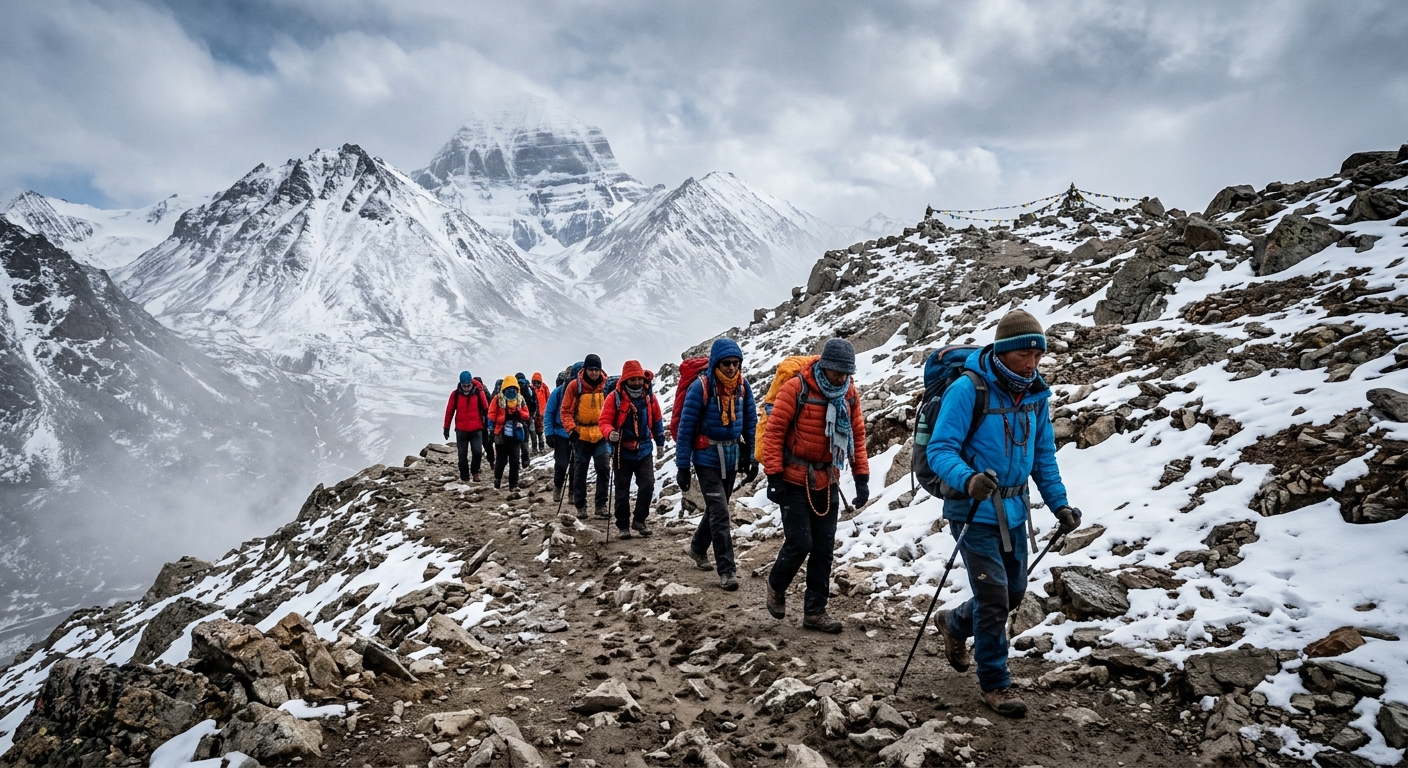
This is what you came for. The 52-kilometer circumambulation of Mount Kailash, spread over three days, with one night at Diraphuk (4,890 meters) and one night at Zuthulphuk (4,790 meters). Altitude, exhaustion, and something that feels bigger than both.
Day 1: Darchen to Diraphuk (20 km, 6 to 8 hours)
You start from Darchen at 4,560 meters. The first stretch is gradual and relatively easy—rolling terrain, prayer flags everywhere, the north face of Kailash visible for most of the walk. You’re fresh, the excitement carries you.
Around kilometer 12, it gets harder. The path climbs. The air thins. Every step requires deliberate effort. We saw people in their 60s and 70s moving slow but steady. Some rode horses or yaks for parts of it—costs around ₹2,000 to ₹3,000 to hire for the day. No shame in it if you’re struggling.
Diraphuk Monastery guesthouse is basic. Shared dormitory, no attached bathroom, no hot water, no heating. Dinner is simple—Tibetan noodle soup, momos if you’re lucky. You sleep in all your layers because it drops to –5°C or lower at night.
Samprita couldn’t sleep—headache, nausea, the altitude doing its thing. Diamox helped a bit, but mostly you just wait it out.
Day 2: Diraphuk to Zuthulphuk via Dolma La Pass (22 km, 10 to 12 hours)
The hardest day. You climb from 4,890 meters to 5,630 meters at Dolma La Pass, then descend steeply to Zuthulphuk at 4,790 meters.
The ascent to Dolma La is brutal. Thin air. Slow pace. Rest every 20 steps. Your lungs burn. People around you are chanting, praying, some crying. It’s physically exhausting and emotionally intense at the same time.
At the pass, there’s a massive rock draped in prayer flags. Pilgrims leave something behind—a piece of clothing, a photo, a personal item—as an offering. The wind is howling. The view is surreal. You don’t stay long because it’s freezing and you’re too tired to stand still.
The descent is knee-destroying. Loose rocks, steep drop, and you’re already exhausted. This stretch took us nine hours total with breaks. Some people take twelve. Don’t rush.
Zuthulphuk guesthouse is similar to Diraphuk—basic, cold, shared. But you’re too tired to care. You eat, you sleep.
Day 3: Zuthulphuk to Darchen (10 km, 3 to 4 hours)
Easy downhill walk. Most people are quiet—physical exhaustion mixed with the weight of what just happened. You reach Darchen by early afternoon.
We sat in our guesthouse room and didn’t talk for an hour. Just processed it.

Best Time to Plan Your Kailash Mansarovar Journey Guide
Timing isn’t optional—it determines whether you complete the yatra or turn back due to weather.
May to June
Peak season. Weather is stable, roads are open, and the maximum number of groups travel during this window. The downside: it’s crowded. Guesthouses fill up fast, and prices are at their highest.
If you’re doing Kailash Mansarovar in 2026 and want the safest weather window, book a May or June batch. Just accept that you’ll share the parikrama trail with hundreds of other pilgrims.
September to Early October
This is when we went, and it was perfect. Post-monsoon, the skies are clear, the weather is cold but manageable, and the crowds thin out. Costs drop slightly, and you get more space on the trail.
The risk: early snowfall. If it snows heavily in late September, some passes close early. We lucked out—no snow, clear skies, stunning visibility of the Kailash peak every single day.
Avoid: July to August
Monsoon season in Nepal makes the roads dangerous. Landslides are common, and entire sections of the route can get blocked. Tibet itself doesn’t get much rain, but the approach through Nepal does. Not worth the risk.
Avoid: November to April
Winter. The region is buried in snow, temperatures drop to –20°C or worse, and most routes close entirely. Unless you have extreme cold-weather experience and a specific reason, don’t attempt this.
Fitness and Health Prep That Actually Matters
You don’t need to be an ultra-marathoner, but you can’t wing this either. Here’s what worked for us and what we wish we’d done better.
Cardio Base
Start training three months before departure. We did 45-minute walks daily, building up to 90-minute walks with a weighted backpack (8 to 10 kg). Stairs help—climb 10 to 15 floors twice a week if you can.
Ketan ran twice a week. I didn’t. We both finished the parikrama fine, but his recovery was faster.
Altitude Acclimatization
There’s no shortcut here. The best prep is spending time at altitude before Kailash. If you can do a trek in Himachal, Uttarakhand, or Ladakh at 3,500 to 4,500 meters a month or two before Kailash, do it. Your body will remember.
We didn’t have time for this, and we paid for it with two rough nights of headaches and nausea.
Medication
Carry Diamox (acetazolamide) for altitude sickness. Start taking it a day before you hit high altitude and continue for two to three days. Dosage: 125 mg twice a day, but confirm with your doctor.
Also carry: Disprin for headaches, Avomine for nausea, Norflox-TZ for stomach issues, and a basic painkiller like Combiflam. Rehydration salts (ORS) are critical—you lose water fast at altitude.
What We Didn’t Do (and Should Have)
Knee strengthening exercises. The descent from Dolma La wrecked our knees. Squats, lunges, and leg presses would’ve helped. Also, we should’ve broken in our trekking boots better—Samprita got blisters on Day 1.
Packing List for Kailash Mansarovar Yatra Experience
Pack light, pack smart. You’re living out of one duffel bag for three weeks, and porters have weight limits (usually 15 kg per person).
Clothing
Thermal inners (two sets), trekking pants (two), fleece jacket, down jacket (rated for –10°C minimum), windproof outer shell, woolen cap, sun hat, gloves (two pairs—one light, one insulated), woolen socks (four pairs), UV-protection sunglasses, neck gaiter.
Footwear
Good trekking boots (waterproof, ankle support). Break them in before you go. Carry an extra pair of comfortable shoes for guesthouse evenings.
Gear
Sleeping bag liner (guesthouses provide blankets, but they’re not always clean), trekking poles (absolutely essential for Dolma La descent), headlamp with extra batteries, daypack (20 to 30 liters), water bottles (two 1-liter bottles), water purification tablets.
Toiletries and Medical
Wet wipes (you won’t get to shower much), hand sanitizer, sunscreen SPF 50+, lip balm, toilet paper, basic first aid kit, all your prescription medications, altitude sickness meds.
Miscellaneous
Power bank (charging points are unreliable in Tibet), universal adapter, ziplock bags (keep documents and electronics dry), snacks (protein bars, dry fruits, chocolates—you’ll crave them), and a small notebook if you want to journal.
Don’t carry: heavy books, unnecessary electronics, expensive jewelry, or extra shoes. You’ll regret the weight.
Frequently Asked Questions
Can senior citizens above 60 complete the Kailash Mansarovar journey?
Yes, if they’re in good health and have prior trekking or walking experience. We saw multiple people in their late 60s and even early 70s complete the parikrama. The key is slow, steady pace and proper acclimatization. Get a full medical checkup before booking, especially cardiac and respiratory tests. Avoid if you have uncontrolled blood pressure, heart conditions, or severe joint issues.
Is the Kailash Mansarovar yatra safe for solo women travelers?
You’re never truly solo—you’re part of a group with a guide and support staff throughout. Samprita felt completely safe. Guesthouses have shared dormitories separated by gender. The bigger challenge is physical, not safety-related. If you’re fit and comfortable in group travel settings, gender isn’t a barrier here.
How much does the Kailash Mansarovar trek cost if you go through a government operator?
The Ministry of External Affairs runs subsidized Kailash Mansarovar Yatra batches through KMVN (Kumaon Mandal Vikas Nigam) at around ₹1.8 lakh to ₹2.2 lakh per person, depending on the route. But seats are limited, and there’s a selection process including a medical test and interview. Applications open once a year, usually in December or January. Success isn’t guaranteed. If you don’t get selected, private operators are your only option.
What happens if someone gets seriously sick during the Mount Kailash pilgrimage?
Emergency evacuation is possible but expensive and complicated. The nearest town with a hospital is Saga, a full day’s drive from Kailash. In extreme cases, helicopter evacuation to Kathmandu can be arranged, but it costs USD 10,000 or more and isn’t always immediately available due to weather and permits. This is exactly why comprehensive travel insurance with high-altitude trekking coverage is non-negotiable. Don’t skip it.
Ready to Take the Kailash Mansarovar Journey? Here’s What to Do Next
If you’ve read this far, you’re seriously considering it. Good. This isn’t a trip you take lightly, and the fact that you’re doing the research means you’re approaching it the right way.
Musafir Couple completed this yatra because we wanted to experience something beyond the usual weekend getaways and resort reviews we share from Pune, Lonavala, and Goa. Kailash Mansarovar pushed us physically and spiritually in ways we didn’t expect, and it’s one of the few journeys we’d tell every serious traveler to attempt at least once if health and budget allow.
Start your prep now for the Kailash Mansarovar 2026 season. Book your tour operator by December 2025 or January 2026 if you’re targeting a May or June batch. Get your fitness routine going. Line up your medical checkup and vaccinations. And mentally prepare for the hardest and most rewarding three weeks of your life.
We’re Ketan and Samprita from Musafir Couple, and we share real travel experiences with honest costs and practical details—not picture-perfect content. If you’ve got questions about the Kailash Mansarovar yatra or want to know which operator we used, drop us a message on Instagram or YouTube. We’ll tell you what actually worked and what you can skip.
The mountain is waiting. And trust us—it’s worth every single step.